Open a Vedic Kundli and you will usually see two signs named at the top: a Lagna and a Rashi. Many people only know one of them, often the one printed on a horoscope page in the newspaper, and are surprised to find a different sign in their chart. Both are correct. They simply describe different things.
Lagna in one paragraph
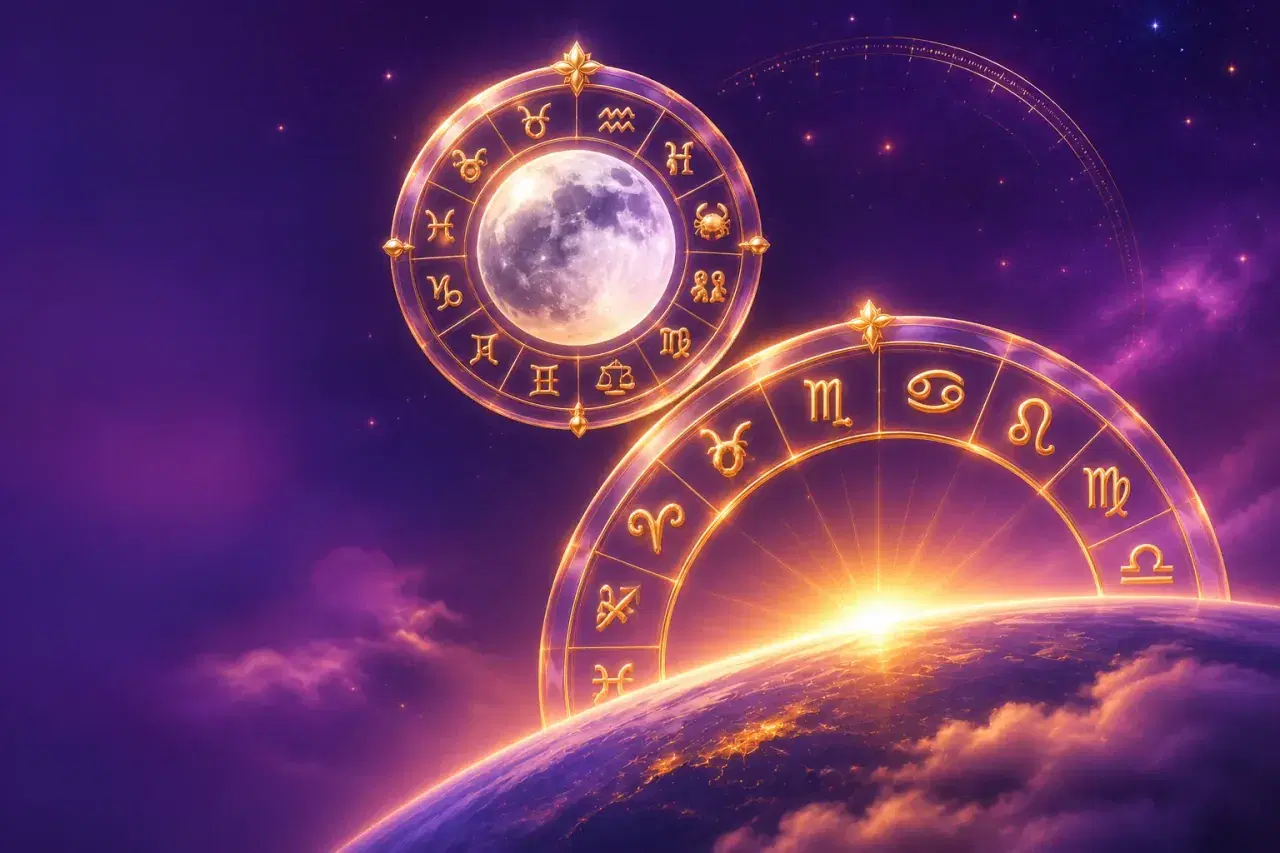
Lagna (लग्न) means "that which is attached" or "the point of contact". It is the sign of the zodiac that was rising over the eastern horizon at the moment of your birth, at the place you were born. Because the Earth turns once a day, all twelve signs rise in turn every 24 hours, so a new sign rises roughly every two hours. That makes the Lagna the most personal point in a chart: two babies born in the same hospital an hour apart can have different Lagnas.
The Lagna becomes the 1st house of your Kundli, and every other house is counted from it. It describes the body, health, temperament and the general direction of life. Its ruling planet, the Lagnesh (Lagna lord), is one of the most important planets in any reading.
Rashi in one paragraph
Rashi (राशि) simply means "sign". When Indians ask "what is your rashi?", they mean your Moon sign (Chandra rashi): the sign the Moon was in at your birth. The Moon moves quickly, crossing a sign in about two and a quarter days, so everyone born within those two days shares the same Rashi, wherever they were born.
The Moon represents the mind (manas), emotions and how you experience life from the inside. Vedic astrology gives it great weight, which is why the Rashi is used for daily horoscopes, Sade Sati, transits and Kundli matching.
Side by side
| Lagna (Ascendant) | Rashi (Moon sign) | |
|---|---|---|
| What it is | Sign rising on the eastern horizon at birth | Sign the Moon was in at birth |
| Changes every | About 2 hours (varies by sign and latitude) | About 2¼ days |
| Needs exact birth time? | Yes | Usually not, unless the Moon changed sign that day |
| Needs birth place? | Yes | No |
| Describes | Body, personality, life path, the whole house structure | Mind, emotions, inner experience |
| Used for | Reading the full Kundli: houses, lords, yogas | Rashifal, Sade Sati, gochar, Guna Milan, naming |
| Called in Hindi | लग्न | राशि, चंद्र राशि |
Why the two are usually different
The Lagna depends on the time of day; the Moon depends on the date. Only if the Moon happened to be rising at your birth will the two match, which happens for roughly one person in twelve. So it is entirely normal to have, for example, a Leo Lagna and Taurus Rashi, as in the worked chart in our guide to how to read a Kundli.
And what about the Sun sign?
Western astrology popularised the Sun sign: the sign the Sun was in at birth. Vedic astrology also records it (sometimes called the "Surya rashi"), but gives it less weight than the Moon or the Lagna. There is a second difference: Western astrology uses the tropical zodiac, while Vedic astrology uses the sidereal zodiac, about 24 degrees apart today. So if a Western website says you are a Taurus, your Vedic Sun sign is most likely Aries.
Which one should you follow?
It depends on what you are reading:
- Daily or yearly rashifal: use your Rashi (Moon sign). Indian rashifal, including ours, is written for the Moon sign.
- Sade Sati and Saturn transits: always counted from the Moon.
- Kundli matching (Guna Milan): uses the Moon's sign and nakshatra. See 36 Guna Milan explained.
- Reading your own chart, career, marriage or health: start from the Lagna and its houses, then cross-check from the Moon. Many astrologers read a transit from both and give more weight to whichever is stronger in the chart.
- Naming a baby: the first syllable (namakshar) comes from the Moon's nakshatra and its pada. Our baby names by nakshatra list does this for you.
How long does each Lagna last?
Signs do not take equal time to rise. Because the ecliptic is tilted, some signs rise quickly (signs of "short ascension") and others slowly. At Indian latitudes, a Lagna can last anywhere from about an hour and a half to about two and a half hours. If you were born close to a change, a few minutes of error in your birth time can give the wrong Lagna, which shifts every house in the chart. The ascendant calculator shows how close your Lagna is to the edge of its sign.
The Moon chart (Chandra Kundli)
Because the Moon matters so much, many Kundlis include a second chart that treats the Moon's sign as the 1st house: the Chandra Kundli. Astrologers read important themes from both charts. When a planet is well placed from both the Lagna and the Moon, its results are considered more certain.