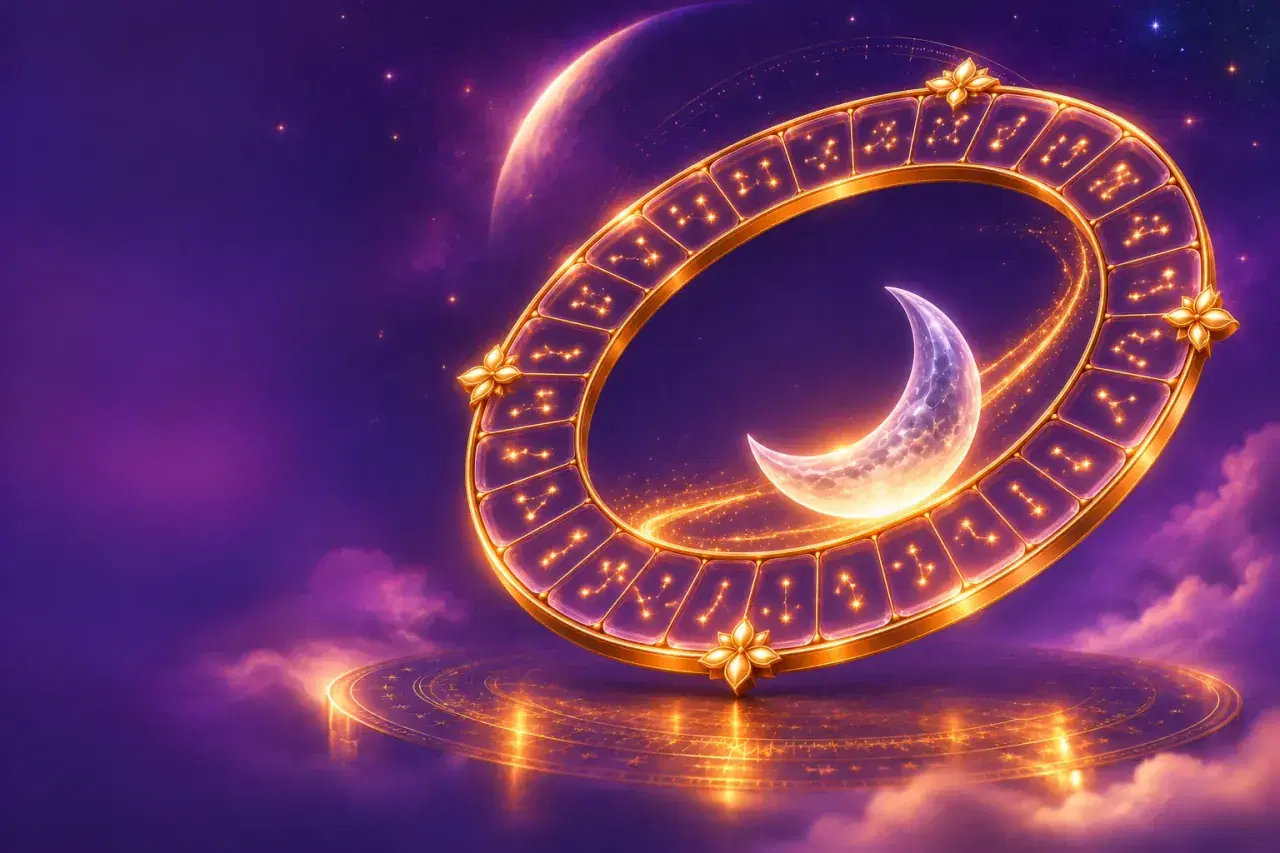
Long before the twelve zodiac signs became standard, Indian astronomers tracked the Moon against the stars. The Moon takes about 27.3 days to return to the same star, so the sky along its path was divided into 27 "lunar mansions" where it rests each night. These are the nakshatras, and they are one of the most distinctive features of Vedic astrology.
The nakshatra in one sentence
A nakshatra is a 13°20′ segment of the sidereal zodiac, one of 27 that together make the full 360°, each named after a star or asterism and each associated with a ruling planet, a deity, a symbol and a set of qualities.
The Sanskrit word is often explained as naksha (map) + tra (guard), "the guardian of the sky map", or as "that which does not decay", a reference to the fixed stars. Nakshatras appear in Vedic literature far older than the zodiac signs, including lists in the Taittiriya Samhita and the Vedanga Jyotisha.
Key numbers
| Measure | Value |
|---|---|
| Number of nakshatras | 27 (28 with Abhijit, used in some muhurta work) |
| Span of each nakshatra | 13°20′ (360° ÷ 27) |
| Padas per nakshatra | 4 |
| Span of each pada | 3°20′ |
| Total padas | 108 |
| Nakshatras per sign | 2¼ (9 padas) |
| Time the Moon spends in one | About a day (roughly 20 to 27 hours) |
The number 108, sacred in Indian tradition, appears here as the total of padas: 27 nakshatras × 4 padas, which also equals 12 signs × 9 padas.
All 27 nakshatras
| No. | Nakshatra | Span (sidereal) | Ruling planet | Deity |
|---|---|---|---|---|
| 1 | Ashwini | Aries 0°00′–13°20′ | Ketu | Ashwini Kumaras |
| 2 | Bharani | Aries 13°20′–26°40′ | Venus | Yama |
| 3 | Krittika | Aries 26°40′–Taurus 10°00′ | Sun | Agni |
| 4 | Rohini | Taurus 10°00′–23°20′ | Moon | Brahma (Prajapati) |
| 5 | Mrigashira | Taurus 23°20′–Gemini 6°40′ | Mars | Soma |
| 6 | Ardra | Gemini 6°40′–20°00′ | Rahu | Rudra |
| 7 | Punarvasu | Gemini 20°00′–Cancer 3°20′ | Jupiter | Aditi |
| 8 | Pushya | Cancer 3°20′–16°40′ | Saturn | Brihaspati |
| 9 | Ashlesha | Cancer 16°40′–30°00′ | Mercury | Nagas |
| 10 | Magha | Leo 0°00′–13°20′ | Ketu | Pitris (ancestors) |
| 11 | Purva Phalguni | Leo 13°20′–26°40′ | Venus | Bhaga |
| 12 | Uttara Phalguni | Leo 26°40′–Virgo 10°00′ | Sun | Aryaman |
| 13 | Hasta | Virgo 10°00′–23°20′ | Moon | Savitr |
| 14 | Chitra | Virgo 23°20′–Libra 6°40′ | Mars | Tvashtr (Vishvakarma) |
| 15 | Swati | Libra 6°40′–20°00′ | Rahu | Vayu |
| 16 | Vishakha | Libra 20°00′–Scorpio 3°20′ | Jupiter | Indra and Agni |
| 17 | Anuradha | Scorpio 3°20′–16°40′ | Saturn | Mitra |
| 18 | Jyeshtha | Scorpio 16°40′–30°00′ | Mercury | Indra |
| 19 | Mula | Sagittarius 0°00′–13°20′ | Ketu | Nirriti |
| 20 | Purva Ashadha | Sagittarius 13°20′–26°40′ | Venus | Apas (waters) |
| 21 | Uttara Ashadha | Sagittarius 26°40′–Capricorn 10°00′ | Sun | Vishvedevas |
| 22 | Shravana | Capricorn 10°00′–23°20′ | Moon | Vishnu |
| 23 | Dhanishta | Capricorn 23°20′–Aquarius 6°40′ | Mars | Eight Vasus |
| 24 | Shatabhisha | Aquarius 6°40′–20°00′ | Rahu | Varuna |
| 25 | Purva Bhadrapada | Aquarius 20°00′–Pisces 3°20′ | Jupiter | Aja Ekapada |
| 26 | Uttara Bhadrapada | Pisces 3°20′–16°40′ | Saturn | Ahir Budhnya |
| 27 | Revati | Pisces 16°40′–30°00′ | Mercury | Pushan |
Notice the ruling planets: the sequence Ketu, Venus, Sun, Moon, Mars, Rahu, Jupiter, Saturn, Mercury repeats three times. This is exactly the order of the Vimshottari dasha, which is why your nakshatra decides the dasha you are born into.
Each nakshatra has its own page on Kundli Naksha with its symbol, gana, qualities and naming syllables. Start with Ashwini, or read Rohini, the Moon's favourite.
What a pada is
Each nakshatra is split into four padas ("feet" or quarters) of 3°20′. The padas are used to:
- Fine-tune the reading. Each pada falls in a different sign of the Navamsa (D9) chart, so two people in the same nakshatra but different padas can show different qualities.
- Choose a name. Each pada carries its own syllable (akshara). For example, the four padas of Ashwini give Chu, Che, Cho, La. Our baby names by nakshatra lists all 108.
- Refine matching exceptions. Same nakshatra but different padas is one of the exceptions to Nadi dosha.
Your birth nakshatra (janma nakshatra)
When people in India speak of "your nakshatra", they mean the nakshatra of the Moon at your birth. Because the Moon changes nakshatra about once a day, you need your date and approximate time of birth to know it; near a change, the exact time decides it.
Your janma nakshatra is used for:
- Dasha timing: its lord rules your first Mahadasha.
- Kundli matching: Tara, Yoni, Gana and Nadi kootas are all calculated from the two partners' nakshatras. See 36 Guna Milan explained.
- Naming: the traditional first syllable of a name (namakshar) comes from the nakshatra pada.
- Muhurta and daily choices: each day's nakshatra is compared with yours (tara bala) when choosing good times; you can see today's nakshatra in the Panchang.
- Personality: classical texts such as Brihat Samhita describe the temperament associated with each birth star.
The Lagna nakshatra (the nakshatra of your Ascendant degree) and the nakshatras of other planets are also read by astrologers, but the Moon's nakshatra is the one meant by default.
Classifications you will see
Nakshatras are classified in several ways, each used for a specific purpose:
| Classification | Groups | Used for |
|---|---|---|
| Gana | Deva, Manushya, Rakshasa | Temperament; Gana koota in matching |
| Nadi | Adi, Madhya, Antya | Nadi koota in matching |
| Yoni | 14 animals (horse, elephant, serpent…) | Yoni koota in matching |
| Nature | Fixed, movable, sharp, soft, fierce, mixed, light | Choosing muhurtas for different activities |
| Direction of face | Upward, downward, level | Muhurta (building, digging, travel) |
Nakshatra vs rashi
A rashi (sign) is 30°, a nakshatra 13°20′. Each sign contains two and a quarter nakshatras, so your Moon sign and Moon nakshatra are related but not the same: two people with the Moon in Taurus may have it in Krittika, Rohini or Mrigashira. The nakshatra is the finer, more personal of the two. For the other sign in your chart, read Lagna vs Rashi.
Abhijit, the 28th nakshatra
Older texts list a 28th nakshatra, Abhijit, around the star Vega, occupying the last part of Uttara Ashadha and the start of Shravana. It is not used in the 27-fold division for charts and dashas, but it remains important in muhurta, and "Abhijit muhurta" around local noon is a well-known auspicious time.