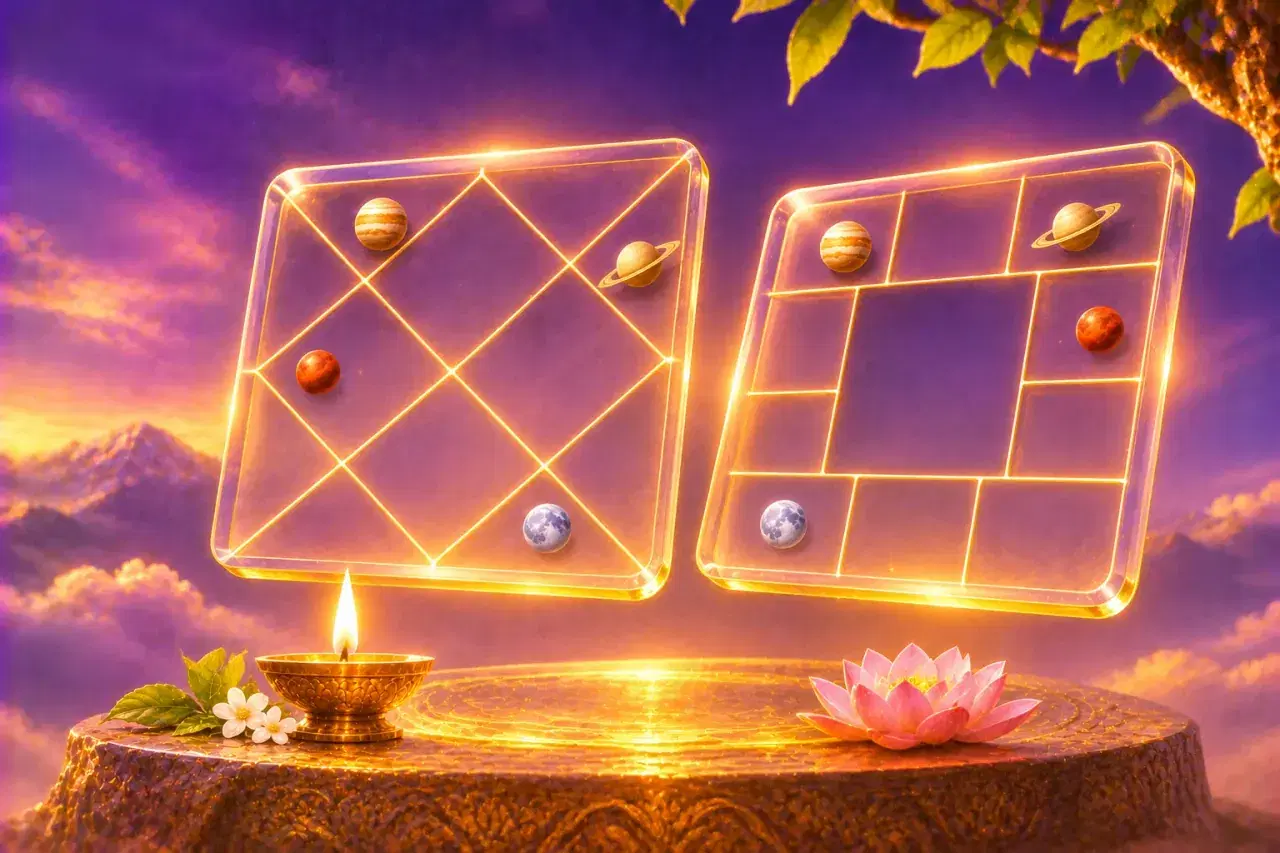
A family in Lucknow and a family in Chennai might show you the same person's Kundli and you would think they were different documents. The first is a square full of diamonds and triangles; the second is a ring of twelve boxes. They are the North Indian and South Indian chart styles, and they hold identical information arranged differently. This guide teaches you to read both. If you are new to Kundlis, start with what a Janam Kundli is.
The one idea to remember
| North Indian | South Indian | |
|---|---|---|
| What stays in the same place | Houses | Signs |
| Where the Lagna is | Always the top-centre diamond | In whichever box holds the Lagna sign, marked |
| Numbers inside mean | Sign numbers (1–12) | Usually none; signs are known by position |
| Direction | Houses anti-clockwise | Signs clockwise |
| Common in | North, West and Central India, Nepal | Tamil Nadu, Kerala, Karnataka, Andhra Pradesh, Telangana, Sri Lanka |
Reading a North Indian chart
The square is divided by its two diagonals and by a diamond joining the midpoints of its sides. That creates four diamonds and eight triangles: twelve houses.
- Find the 1st house. It is always the top-centre diamond. The number written in it is your Lagna sign.
- Count anti-clockwise. The small triangle to the upper left is the 2nd house, the triangle below it the 3rd, the left diamond the 4th, then the 5th and 6th triangles, the bottom diamond the 7th, the 8th and 9th triangles, the right diamond the 10th, and the 11th and 12th triangles back to the top.
- Read the numbers as signs. 1 = Aries, 2 = Taurus, 3 = Gemini, 4 = Cancer, 5 = Leo, 6 = Virgo, 7 = Libra, 8 = Scorpio, 9 = Sagittarius, 10 = Capricorn, 11 = Aquarius, 12 = Pisces.
- Read the planets written in each house.
The four diamonds are the four kendras (1st, 4th, 7th, 10th), which makes the angular houses easy to spot at a glance.
Reading a South Indian chart
A square grid of 4 × 4 boxes, with the four centre boxes left empty (often used for the name or details). The twelve outer boxes are the twelve signs, always in the same place:
| Pisces | Aries | Taurus | Gemini |
|---|---|---|---|
| Aquarius | Cancer | ||
| Capricorn | Leo | ||
| Sagittarius | Scorpio | Libra | Virgo |
- Find the Lagna. Look for the box marked with a diagonal line, "Asc", "La" or "Lagna". That sign is your 1st house.
- Count clockwise from that box for the 2nd, 3rd and later houses.
- Read the planets in each box; their sign is simply the box they sit in.
The same chart, drawn both ways
Here is the chart used throughout our guides: a person born on 15 August 1990 at 6:30 am in Delhi, Leo Lagna.
North Indian layout (as a list)
| House | Position | Sign number | Planets |
|---|---|---|---|
| 1st | Top-centre diamond | 5 (Leo) | Lagna, Mercury |
| 2nd | Top-left triangle | 6 (Virgo) | — |
| 3rd | Upper-left side triangle | 7 (Libra) | — |
| 4th | Left diamond | 8 (Scorpio) | — |
| 5th | Lower-left side triangle | 9 (Sagittarius) | Saturn |
| 6th | Bottom-left triangle | 10 (Capricorn) | Rahu |
| 7th | Bottom-centre diamond | 11 (Aquarius) | — |
| 8th | Bottom-right triangle | 12 (Pisces) | — |
| 9th | Lower-right side triangle | 1 (Aries) | Mars |
| 10th | Right diamond | 2 (Taurus) | Moon |
| 11th | Upper-right side triangle | 3 (Gemini) | — |
| 12th | Top-right triangle | 4 (Cancer) | Sun, Jupiter, Venus, Ketu |
South Indian layout
| Pisces: — | Aries: Mars | Taurus: Moon | Gemini: — |
|---|---|---|---|
| Aquarius: — | Cancer: Sun, Jupiter, Venus, Ketu | ||
| Capricorn: Rahu | Leo: Lagna, Mercury | ||
| Sagittarius: Saturn | Scorpio: — | Libra: — | Virgo: — |
Same planets, same signs, same houses. In the South Indian chart, counting clockwise from Leo: Virgo is the 2nd house, Libra the 3rd, and so on to Cancer, the 12th, which holds four planets, exactly as in the North Indian chart.
Converting between the two
North to South: for each house in the North Indian chart, take its sign number and place the planets in that sign's fixed box in the South Indian grid. Mark the Lagna sign's box.
South to North: write the Lagna sign's number in the top diamond, then write the next sign numbers anti-clockwise. Copy each planet into the house holding its sign.
The East Indian style
In Bengal, Odisha and parts of the North-East, a third style is used. Like the South Indian chart, it fixes the signs rather than the houses, but arranges them differently in a square divided into boxes and triangles. The principle is the same: find the box marked as the Lagna and count from there.
Which style is better?
Neither. Astrologers trained in one style read it faster, and that is all. North Indian charts make the houses (and so the kendras and trikonas) instantly visible; South Indian charts make the signs, and therefore transits and aspects by sign, instantly visible. Use whichever your family uses, and learn to recognise the other. Then continue with how to read a Kundli.