Of the twenty-four Ekadashis in the year, few are celebrated as warmly as Dev Uthani Ekadashi. In villages across North India, courtyards are decorated with rice-flour drawings, sugarcane stalks are tied into little canopies, and families gather at dusk to sing the gods awake. It is also the day the wedding season quietly reopens. This guide explains what the day means, the stories told about it, and how it is traditionally observed.
What the name means
The festival has several names, all describing the same idea:
| Name | Meaning |
|---|---|
| Dev Uthani / Devutthana Ekadashi | "The Ekadashi on which the gods rise" |
| Prabodhini Ekadashi | "The Ekadashi of awakening" |
| Haribodhini Ekadashi | "The Ekadashi on which Hari (Vishnu) wakes" |
| Kartiki Ekadashi | "The Ekadashi of Kartik", the name used in Maharashtra |
It falls on the eleventh lunar day (Ekadashi) of the waxing fortnight (Shukla paksha) of Kartik, usually in late October or November.
Why Vishnu "sleeps" and "wakes"
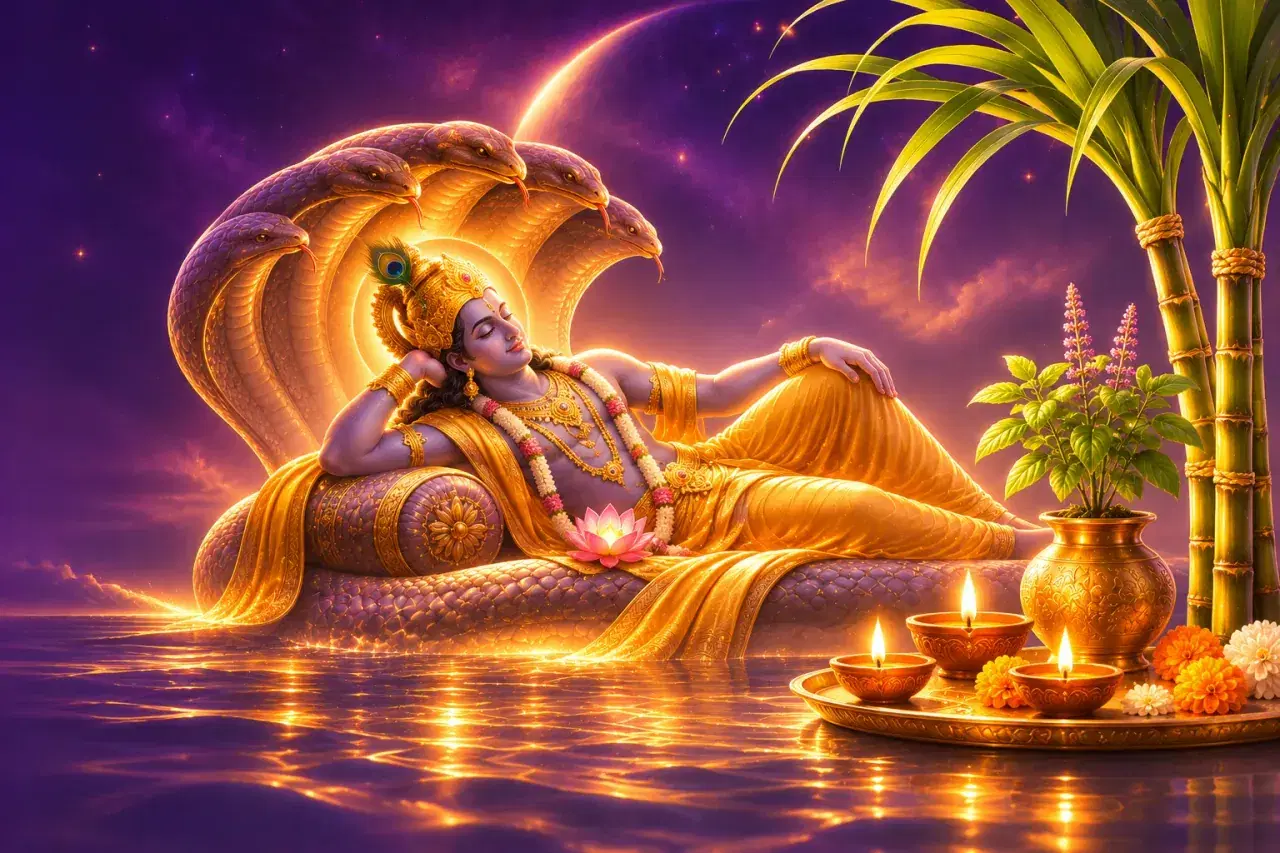
Hindu tradition describes Vishnu resting on the coils of the serpent Shesha in the cosmic ocean. Once a year he enters a four-month yoga nidra, a meditative sleep. It begins on Devshayani Ekadashi (Ashadha Shukla Ekadashi, around June or July) and ends on Dev Uthani Ekadashi. The months in between are called Chaturmas, "the four months".
Puranic and folk traditions tell more than one story about why this happens.
The story of Vamana and King Bali
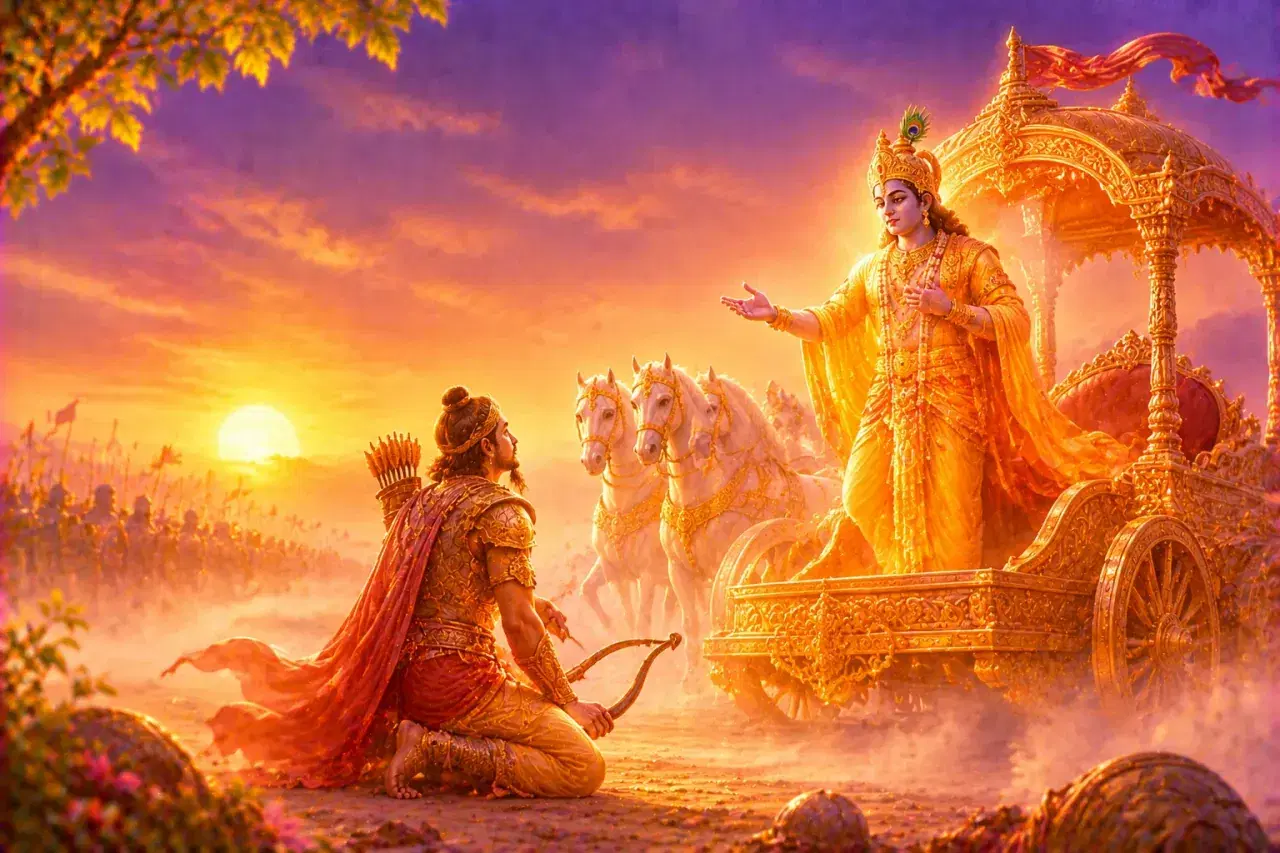
The most widely told version links the sleep to Vamana, Vishnu's dwarf incarnation. The generous demon-king Bali had grown so powerful that he ruled all three worlds. Vishnu came to him as a small Brahmin boy and asked for just three steps of land. Bali agreed. Vamana then grew to cosmic size, covered the earth and the heavens in two steps, and Bali, true to his word, offered his own head for the third.
Pleased by Bali's devotion and honesty, Vishnu made him king of the netherworld (Patala) and granted him a boon. In many tellings, Bali asked Vishnu to stay with him, and Vishnu agreed to spend part of each year in his realm. The four months of Chaturmas are popularly understood as that time, and Dev Uthani Ekadashi as Vishnu's return.
Rest after battle
Other tellings say Vishnu rested after a long battle with a demon, sometimes named as Shankhasura, and that the gods asked him to keep a regular period of rest so that his awakening would bring renewed blessings to the world. Different regions and texts emphasise different stories; what they share is the image of the preserver of the universe resting and then returning to his work.
What the story means
Many teachers read the story symbolically. Chaturmas coincides with the monsoon, traditionally a time for staying in one place, for study, fasting and inward practice; wandering monks stopped travelling and stayed in one village. Vishnu's awakening at the end of the rains marks a return to outward activity: travel, celebration, marriage and new beginnings.
Why weddings begin again
During Chaturmas, Hindu families traditionally avoid weddings, griha pravesh (moving into a new home), mundan and other major ceremonies, because the deity who presides over the order of the world is "asleep". With Vishnu's awakening, auspicious ceremonies can begin again. That is why the weeks after Dev Uthani Ekadashi are among the busiest wedding weeks of the year, and why many families plan their first wedding muhurat for this period. If you are choosing a date, the muhurat finder shows auspicious windows for your city.
How Dev Uthani Ekadashi is observed
Customs vary from region to region and family to family. These are the most common.
The fast (vrat)
- The day before (Dashami): many eat a single simple meal and avoid grains in the evening.
- On Ekadashi: devotees fast from sunrise. Some keep a nirjala fast without water; most keep a phalahar fast of fruit, milk, nuts and permitted foods such as sabudana, potatoes, singhara (water chestnut) flour or kuttu. Rice and other grains are avoided on every Ekadashi.
- Breaking the fast (parana): the fast is broken on the next morning, Dvadashi, within the parana window given in the Panchang, traditionally after worship and after offering food to others.
People who are unwell, pregnant, elderly or on medication are traditionally exempted from strict fasting, and many families observe a light fast instead. Health always comes first.
Worship (puja)
A simple home puja usually includes:
- Cleaning the home and the place of worship in the morning, and bathing.
- Placing an image or idol of Vishnu (or Krishna, or a Shaligram) on a clean cloth.
- Offering water, flowers, tulsi leaves, sandalwood paste, incense, a ghee lamp and seasonal fruits.
- Reading or listening to the Ekadashi katha and chanting a Vishnu mantra such as Om Namo Bhagavate Vasudevaya or the Vishnu Sahasranama.
- In the evening, performing aarti and the awakening ritual.
Waking the gods
The best-loved custom of the day happens at dusk. In many homes in Uttar Pradesh, Bihar and nearby regions, women draw the feet of the gods or simple figures of the deities on the floor with rice-flour paste or chalk. Sugarcane stalks are tied together to form a small canopy (mandap) over the drawing, and seasonal produce such as sugarcane, singhara, sweet potato, ber (jujube), radish and new grain is placed beneath. The offerings are covered with a sieve or basket.
Then the family gathers, rings bells or taps a thali, and sings to wake the gods. A widely sung refrain begins "Utho Dev, baitho Dev..." ("Rise, O gods, be seated, O gods..."). Lamps are lit around the home, much as on Diwali, and the gods are invited to bless the household and the auspicious season ahead.
Tulsi Vivah
Many families celebrate Tulsi Vivah, the ceremonial marriage of the sacred tulsi plant to Vishnu (as Shaligram or Krishna), on Dev Uthani Ekadashi or on Dvadashi, the next day; some continue celebrating until Kartik Purnima. The tulsi plant is dressed like a bride, a small mandap of sugarcane is built, and the wedding rites are performed with songs and sweets. It is seen as the first wedding of the new season.
Pandharpur and Kartiki Ekadashi
In Maharashtra, Kartiki Ekadashi is one of the two great pilgrimage days at the Vitthal temple in Pandharpur, alongside Ashadhi Ekadashi. Devotees (warkaris) arrive singing the abhangas of the saints, and the official worship at the temple is performed on behalf of the state.
The days around it
| Day | Observance |
|---|---|
| Devshayani Ekadashi (Ashadha Shukla 11) | Vishnu's sleep begins; Chaturmas starts |
| Dev Uthani Ekadashi (Kartik Shukla 11) | Vishnu awakens; Chaturmas ends |
| Dvadashi (next day) | Parana (breaking the fast); Tulsi Vivah in many homes |
| Ekadashi to Kartik Purnima | Bhishma Panchaka, five days of special observance in some traditions |
| Kartik Purnima | Dev Deepawali in Varanasi; holy bathing; end of the Kartik month's observances |
Is there an astrological side?
Ekadashi is defined by the angle between the Sun and the Moon: it is the eleventh tithi, the period in which the Moon moves from 120° to 132° ahead of the Sun. Because the tithi does not line up neatly with the calendar day, the date of an Ekadashi depends on where you are and on the rule your tradition follows for which day the tithi "belongs" to. Kundli Naksha's Panchang calculates the tithi at sunrise for your city, which is the rule most households follow.