Few books have shaped as many lives as the Bhagavad Gita. Once a year, on Gita Jayanti, Hindus honour the day it was spoken: a conversation between Krishna and a despairing Arjuna in the moments before the great war of the Mahabharata. The day is also Mokshada Ekadashi, one of the most important Ekadashis of the year.
When is Gita Jayanti 2026?
Sunday 20 December 2026 (Margashirsha Shukla Ekadashi), by the sunrise tithi for Delhi, with parana (breaking the fast) on the morning of 21 December. See the Ekadashi 2026 page for times in your city.
Why Gita Jayanti is celebrated
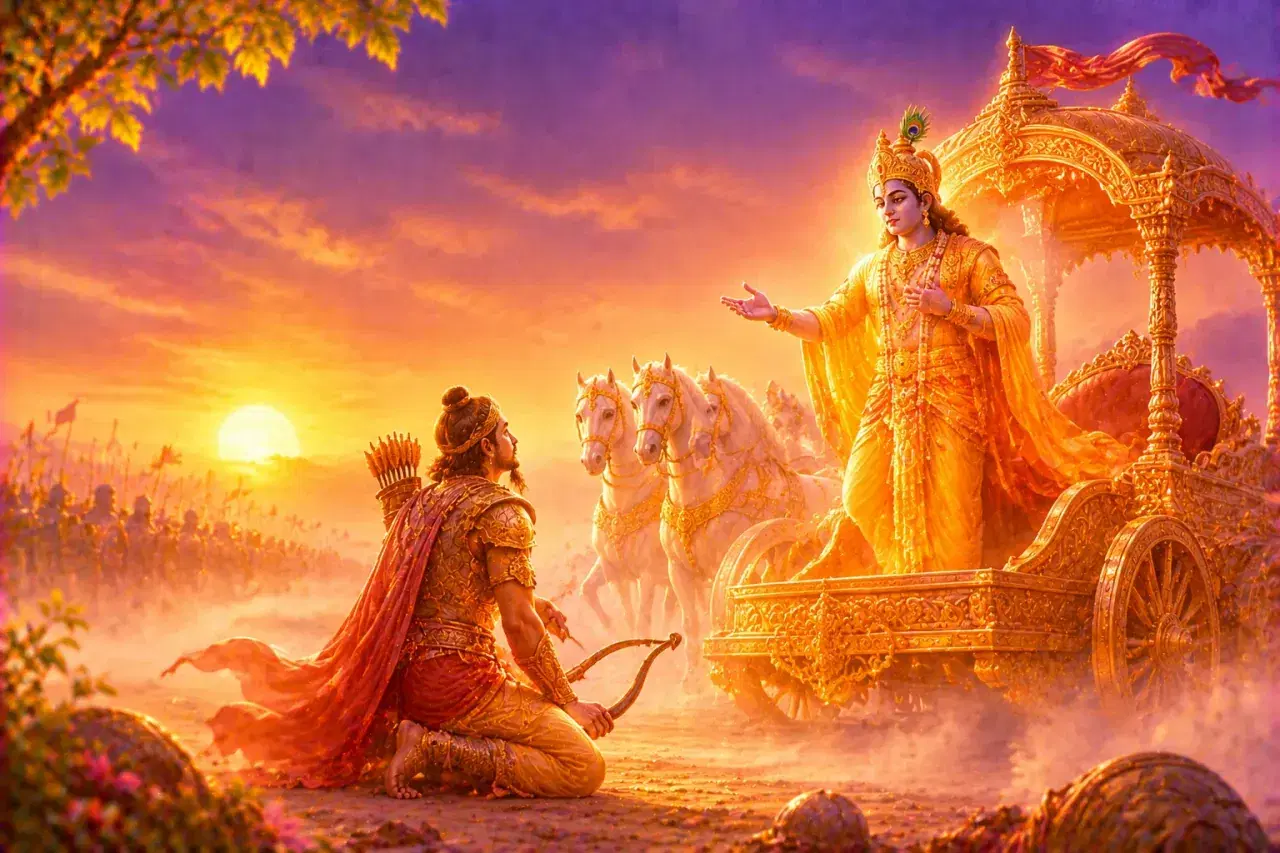
The Bhagavad Gita ("Song of the Lord") is a 700-verse dialogue in the Bhishma Parva of the Mahabharata. As the armies of the Pandavas and Kauravas faced each other at Kurukshetra, Arjuna saw his teachers, grandfather and cousins on the other side and refused to fight. His charioteer, Krishna, answered his grief and confusion with the teaching that became the Gita. Tradition holds that this conversation took place on Margashirsha Shukla Ekadashi. For Krishna's life story, see Krishna's life in stories.
The Gita in brief
The Gita has 18 chapters and 700 verses. Its central ideas:
| Teaching | In plain words |
|---|---|
| The self (atman) is eternal | "It is not born, nor does it ever die" (2.20): the true self is not destroyed with the body |
| Svadharma | Do your own duty, according to your nature and role, rather than another's |
| Karma yoga | Act fully, but without attachment to the results (2.47) |
| Jnana yoga | The path of knowledge: seeing the self in all beings |
| Bhakti yoga | The path of loving devotion to the divine |
| Equanimity | Stay steady in success and failure, pleasure and pain |
| The universal form | In chapter 11, Krishna reveals his cosmic form (vishvarupa) to Arjuna |
| Surrender | "Abandon all dharmas and take refuge in me alone" (18.66) |
Different traditions, from Shankara's Advaita to Ramanuja's Vishishtadvaita and the Bhakti schools, read these teachings in different ways, and thinkers from Gandhi to Vivekananda have drawn on it.
The Mokshada Ekadashi katha
In the Ekadashi tradition, Krishna tells this story to Yudhishthira.
King Vaikhanasa of Champaka ruled his people wisely. One night he dreamed that his late father was suffering in the realm of the dead. Distressed, he asked the learned Brahmins what to do, and they sent him to the sage Parvata. The sage revealed that his father suffered because of a wrong done in his lifetime, and advised the king to fast on the Ekadashi of the bright fortnight of Margashirsha and offer its merit to his father.
The king and his family kept the fast with devotion. As they offered its merit, the king's father was freed and blessed his son on his way to heaven. Because it grants liberation (moksha), this Ekadashi is called Mokshada.
How the day is observed
- Fast according to the Ekadashi vrat rules: no grains or pulses; fruits, milk and fasting foods, or a stricter fast if health allows.
- Worship Krishna with tulsi leaves, flowers, a ghee lamp and offerings, often before a picture of Krishna and Arjuna on the chariot.
- Read the Gita: a full recitation of all 18 chapters, a few chapters, or simply chapter 12 (on devotion) or chapter 15. Many people read one chapter a day leading up to the festival.
- Gita daan: gifting copies of the Gita is a popular custom.
- Break the fast on Dvadashi within the parana window.
Kurukshetra
The city of Kurukshetra in Haryana, where the battle is said to have been fought, holds the International Gita Mahotsav around this time, with recitations, aartis at the Brahma Sarovar, cultural programmes and lakhs of visitors. ISKCON and many other temples worldwide hold Gita recitations and discourses.
Mokshada and the Ekadashis around it
Mokshada Ekadashi comes about two weeks after Utpanna Ekadashi, the day Ekadashi herself was born. In the South Indian calendar, the Ekadashi in this period is often celebrated as Vaikuntha Ekadashi, when the "gates of Vaikuntha" are opened in Vishnu temples; depending on the year, it may fall on this Ekadashi or the next one.