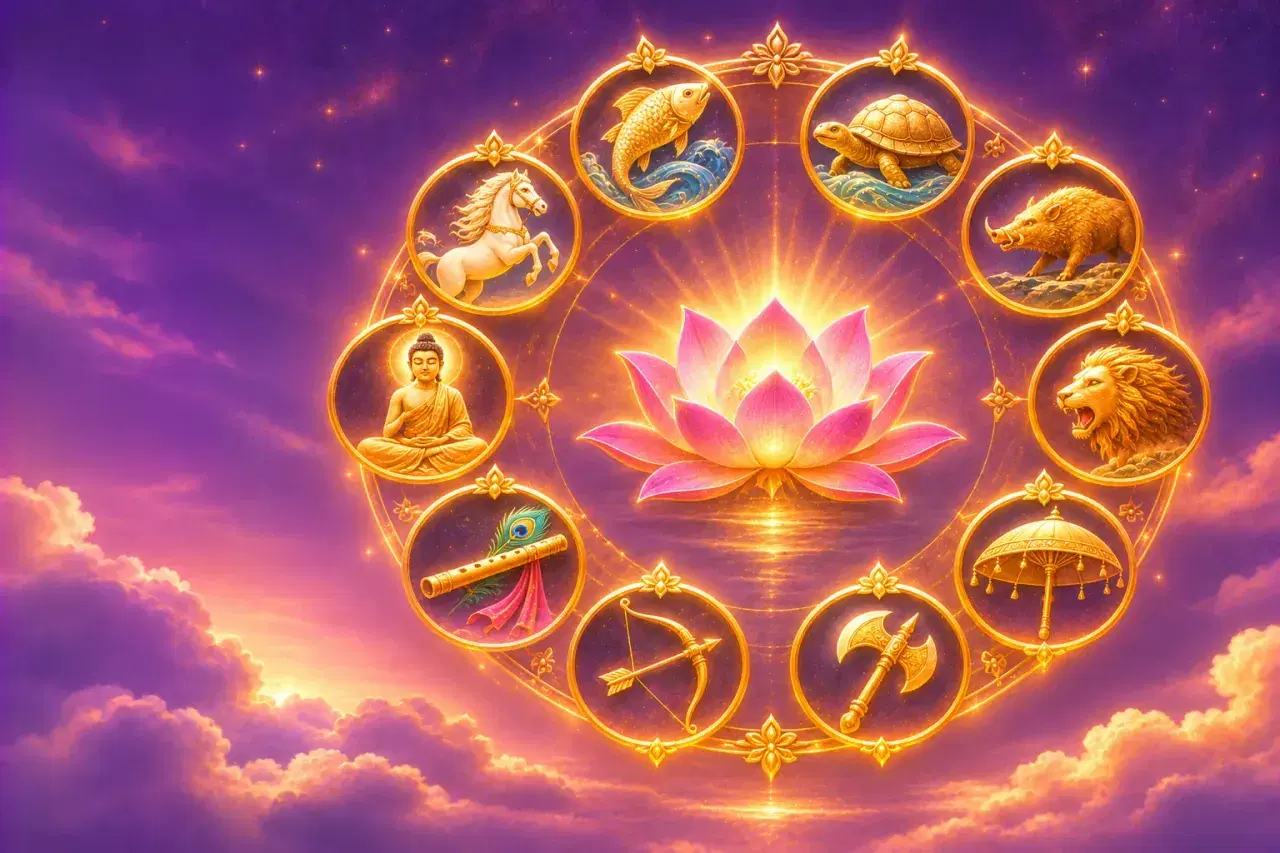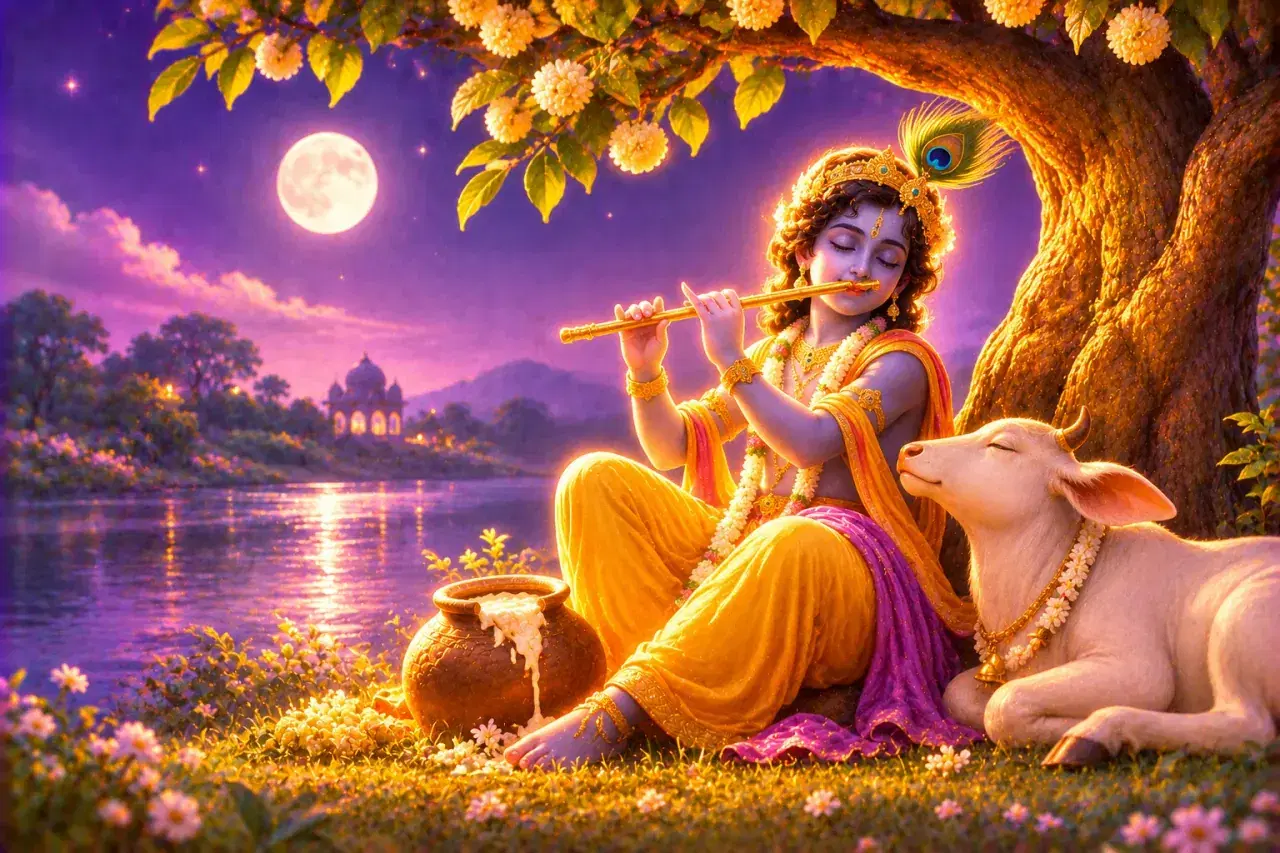
No figure in Hindu tradition is loved in as many ways as Krishna: as a mischievous child, a cowherd with a flute, a divine lover, a clever statesman, a loyal friend and the teacher of the Bhagavad Gita. His stories come mainly from the tenth book of the Bhagavata Purana, the Harivamsha and the Mahabharata. Here is his life in its best-known episodes. For his place among Vishnu's avatars, see the Dashavatara.
Birth: a prison at midnight
The tyrant king Kamsa of Mathura heard a prophecy that the eighth child of his sister Devaki would kill him. He imprisoned Devaki and her husband Vasudeva and killed each of their children at birth. The seventh, Balarama, was miraculously transferred to the womb of Rohini.
The eighth child, Krishna, was born at midnight on the eighth day of the dark fortnight of Bhadrapada, under the nakshatra Rohini. The guards fell asleep, the prison doors opened, and Vasudeva carried the baby across the flooded Yamuna, sheltered by the hoods of the serpent Shesha, to Gokul. There he exchanged him for the newborn daughter of Yashoda and Nanda, and Krishna grew up as their son. Janmashtami celebrates this night.
Childhood in Gokul and Vrindavan
The demons sent by Kamsa
Kamsa sent demons to find and kill the child. The demoness Putana, disguised as a nurse, tried to poison him with her milk; the infant drew out her life instead. Others came as a whirlwind (Trinavarta), a calf, a crane and a giant serpent, and each was defeated by the small boy.
The butter thief (Makhan Chor)
Krishna and his friends raided the cowherd women's pots of butter and curd, even when they were hung from the ceiling, and the gopis' complaints to Yashoda are some of the most affectionate stories in Indian literature. The Dahi Handi festival in Maharashtra re-enacts them.
The universe in his mouth
When his friends complained that Krishna had eaten mud, Yashoda made him open his mouth, and saw in it the whole universe: stars, planets, worlds and herself. The vision faded, and she held him again as simply her child.
Damodara
Exasperated by his mischief, Yashoda tried to tie him to a heavy grinding mortar, but every rope was two fingers too short, until, seeing her tiredness, he let himself be bound. From this he is called Damodara, "one bound at the waist". Dragging the mortar, he freed two cursed demigods trapped as trees.
Kaliya
The serpent Kaliya poisoned a pool of the Yamuna. Krishna dived in, overpowered him and danced on his many hoods until the serpent surrendered, then sent him away to the sea.
Lifting Govardhan
Krishna persuaded the people of Vraja to worship Govardhan hill, which fed their cows, instead of Indra. Angry, Indra sent a week of torrential rain. Krishna lifted the whole hill on his little finger and held it up like an umbrella for seven days, sheltering everyone. Indra was humbled. Govardhan Puja and Annakut, the day after Diwali, remember this.
The flute, the gopis and Radha
Krishna's flute drew the cowherd women from their homes into the moonlit forest for the Raas Leela, a dance in which, the stories say, each gopi felt he danced with her alone. Above all stands Radha, whose love for Krishna became the supreme image of the soul's longing for the divine in Bhakti poetry and devotion.
Mathura: the end of Kamsa
As a youth, Krishna went to Mathura with Balarama, defeated Kamsa's wrestlers and finally Kamsa himself, freeing his parents and restoring the rightful king. Leaving Vrindavan meant parting from Radha and the gopis, and their grief is the subject of countless songs.
Dwarka and friendship
Dwarka
To protect his people from repeated attacks, Krishna built the city of Dwarka on the western sea and ruled there. He married Rukmini, who had written to him asking to be rescued from an unwanted marriage, and others.
Sudama
His childhood friend Sudama, a poor Brahmin, came to Dwarka with only a handful of flattened rice (poha) as a gift, too embarrassed to ask for help. Krishna embraced him, washed his feet, joyfully ate the rice, and sent him home without a word of the favour. When Sudama returned, his hut had become a palace. The story is India's great parable of friendship and humility.
The Mahabharata
Krishna was a cousin and friend of the Pandavas.
- When Draupadi was humiliated in the Kaurava court and her sari pulled away, she called on Krishna, and the cloth became endless.
- He went to the Kauravas as a messenger of peace, asking for just five villages for the Pandavas, and was refused.
- In the war, he refused to fight but became Arjuna's charioteer.
The Bhagavad Gita
On the battlefield of Kurukshetra, Arjuna, seeing his teachers and relatives on the other side, lost the will to fight. Krishna's teaching to him, the Bhagavad Gita, covers duty (dharma), action without attachment to results (karma yoga), knowledge, devotion (bhakti), and the nature of the self. At its climax Krishna reveals his universal form (vishvarupa). It is one of the most influential texts ever composed.
Departure
Years after the war, the Yadava clan destroyed itself in a drunken quarrel. Krishna sat in meditation in the forest near Prabhasa, where a hunter named Jara, mistaking his foot for a deer, shot him with an arrow. Krishna forgave him and left the world. Tradition marks this as the beginning of the Kali Yuga, and Dwarka was claimed by the sea.
Festivals of Krishna
| Festival | What it celebrates |
|---|---|
| Janmashtami | Krishna's birth at midnight. See the Janmashtami page |
| Dahi Handi | His butter-stealing |
| Govardhan Puja / Annakut | Lifting Govardhan hill |
| Holi in Braj | The colours of Radha and Krishna |
| Gita Jayanti | The day the Gita was taught |
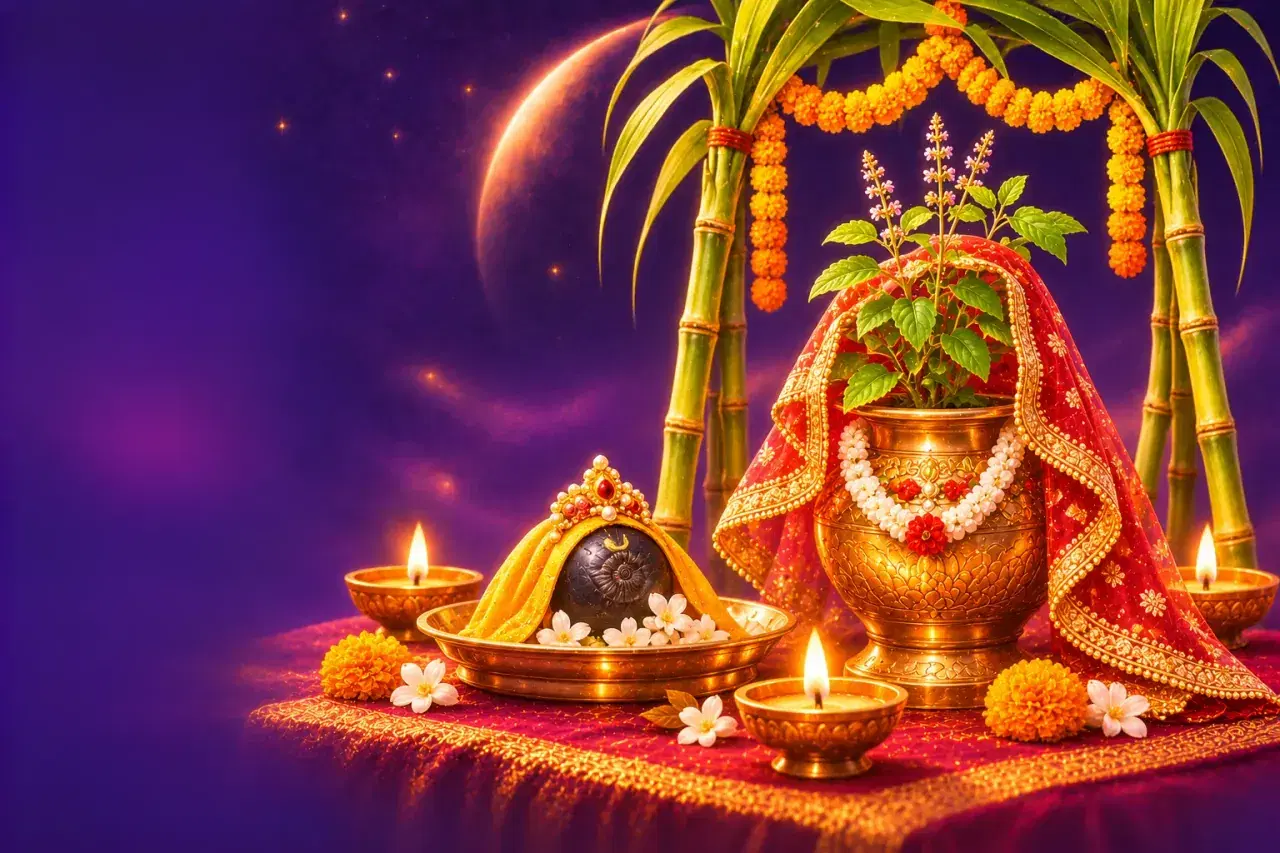
| Tulsi Vivah | The marriage of Tulsi to Vishnu, often as Krishna. See Tulsi Vivah |