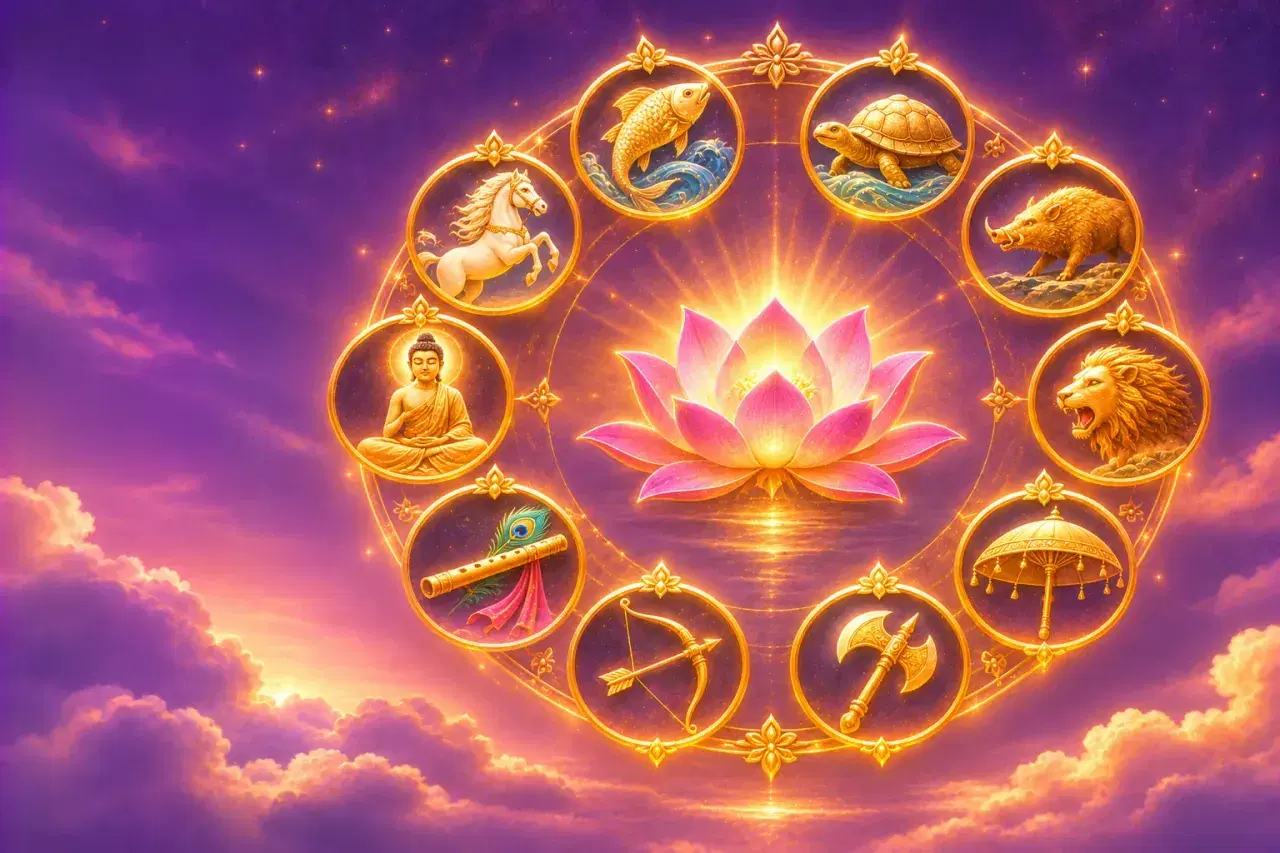
These verses explain the idea of the avatar, literally "descent": the divine coming down into the world in a form suited to the need of the age. Vishnu, the preserver in the Hindu trinity, is said to have many avatars, but ten are counted as principal: the Dashavatara. Here are their stories.
The ten avatars at a glance
| # | Avatar | Form | Yuga | Key story |
|---|---|---|---|---|
| 1 | Matsya | Fish | Satya | Saves Manu and the Vedas from the great flood |
| 2 | Kurma | Tortoise | Satya | Supports Mount Mandara during the churning of the ocean |
| 3 | Varaha | Boar | Satya | Lifts the Earth from the cosmic ocean, slays Hiranyaksha |
| 4 | Narasimha | Man-lion | Satya | Protects Prahlad, slays Hiranyakashipu |
| 5 | Vamana | Dwarf Brahmin | Treta | Takes three steps to reclaim the worlds from Bali |
| 6 | Parashurama | Warrior-sage with an axe | Treta | Humbles the arrogant kings |
| 7 | Rama | Prince of Ayodhya | Treta | The Ramayana: defeats Ravana |
| 8 | Krishna (or Balarama) | Cowherd, king, teacher | Dvapara | The Mahabharata and the Bhagavad Gita |
| 9 | Buddha (in many lists) | The awakened one | Kali | Teaches compassion and non-violence |
| 10 | Kalki | Rider on a white horse | End of Kali | Will end the dark age and begin a new Satya Yuga |
The stories
1. Matsya, the fish
The sage-king Manu was bathing when a tiny fish asked him for protection. He placed it in a jar, then a pond, then the sea, and it kept growing. The fish revealed itself as Vishnu and warned of a great flood. Manu built a boat, gathered seeds, animals and the seven sages, and tied the boat to the fish's horn with the serpent Vasuki as a rope. Matsya towed them safely through the deluge and recovered the Vedas, which a demon had stolen.
2. Kurma, the tortoise
When the gods and asuras churned the ocean of milk for amrita, the nectar of immortality, they used Mount Mandara as the churning rod. The mountain began to sink. Vishnu became a giant tortoise and held it on his back so the churning could go on. From the ocean came poison (which Shiva drank, as told in our guide to Lord Shiva), Lakshmi, the wish-granting cow and finally amrita.
3. Varaha, the boar
The demon Hiranyaksha dragged the Earth (Bhudevi) down into the depths of the cosmic ocean. Vishnu took the form of a mighty boar, dived into the waters, slew the demon after a long battle and raised the Earth on his tusks, restoring her to her place.
4. Narasimha, the man-lion
Hiranyaksha's brother, Hiranyakashipu, won a boon that he could be killed by neither man nor beast, neither inside nor outside, neither by day nor by night, neither on the ground nor in the sky, by no weapon. He demanded to be worshipped, but his young son Prahlad remained devoted to Vishnu despite every torment. When the king struck a pillar and asked whether Vishnu was there, Narasimha burst out of it: half man, half lion. At twilight, on the threshold, holding the king on his lap, he slew him with his claws, honouring every condition of the boon. The story of Prahlad and his aunt Holika is also why we celebrate Holika Dahan.
5. Vamana, the dwarf
The generous asura king Bali had conquered the three worlds. Vishnu came to his sacrifice as a small Brahmin boy and asked for three steps of land. Bali agreed. Vamana grew into the cosmic form Trivikrama, covered the earth and the heavens in two steps, and Bali offered his own head for the third. Vishnu sent him to rule the netherworld and blessed him; Kerala's Onam celebrates Bali's yearly return. A popular telling links this story to Vishnu's four-month sleep, which ends on Dev Uthani Ekadashi.
6. Parashurama, Rama with the axe
Born to the sage Jamadagni, Parashurama received an axe (parashu) from Shiva. When the arrogant king Kartavirya Arjuna stole his father's sacred cow and his sons later killed Jamadagni, Parashurama swore to rid the earth of tyrannical kings and fought them across generations. He is one of the chiranjivis, those said to live until the end of the age, and appears again in the Ramayana and the Mahabharata.
7. Rama, the ideal king
Prince Rama of Ayodhya, exiled for fourteen years with his wife Sita and brother Lakshmana, loses Sita to the demon king Ravana, finds her with the help of Hanuman and the vanara army, and defeats Ravana in Lanka. Rama is honoured as maryada purushottama, the ideal of righteous conduct. Diwali celebrates his return to Ayodhya; Ram Navami, his birth.
8. Krishna, the beloved teacher
Born in a prison in Mathura and raised among the cowherds of Gokul and Vrindavan, Krishna is the playful child, the divine lover of Radha, the slayer of Kamsa, the king of Dwarka and, above all, the charioteer who taught Arjuna the Bhagavad Gita on the battlefield of Kurukshetra. Some lists, especially in South India and in traditions that see Krishna as the source of all avatars, count his brother Balarama as the eighth avatar instead.
9. Buddha
Many Puranic lists, from roughly the middle of the first millennium onward, include the Buddha as the ninth avatar, honoured for teaching compassion and non-violence. Some regional lists, especially in Maharashtra and Odisha, place Jagannath or Vithoba here, and some Vaishnava traditions list Balarama.
10. Kalki, the one to come
At the end of the Kali Yuga, the present age, Vishnu is said to appear as Kalki, riding a white horse named Devadatta and bearing a blazing sword, to end the age of darkness and begin a new Satya Yuga.
Why the lists differ
The idea of the ten avatars developed over centuries, and different Puranas give different lists. The Bhagavata Purana even lists twenty-two avatars and adds that they are "countless". The ten above are the most widely accepted grouping today, but variations, especially for the eighth and ninth places, are part of a living tradition rather than errors.
The avatars and the planets
Brihat Parashara Hora Shastra, the classical text of Vedic astrology, links each of the nine grahas with an avatar of Vishnu:
| Planet | Avatar |
|---|---|
| Sun | Rama |
| Moon | Krishna |
| Mars | Narasimha |
| Mercury | Buddha |
| Jupiter | Vamana |
| Venus | Parashurama |
| Saturn | Kurma |
| Rahu | Varaha |
| Ketu | Matsya |
Some devotees worship the avatar connected with a planet that is important in their chart. It is a devotional association, not a remedy that guarantees any result.
A reading of the sequence
Many modern readers notice that the sequence moves from water (fish) to amphibian (tortoise) to land animal (boar) to half-human (man-lion) to small human (dwarf) to increasingly complete human forms, and see in it a poetic picture of evolution. Traditional teachers read it more as a picture of the divine meeting each age's need in the form that age requires.