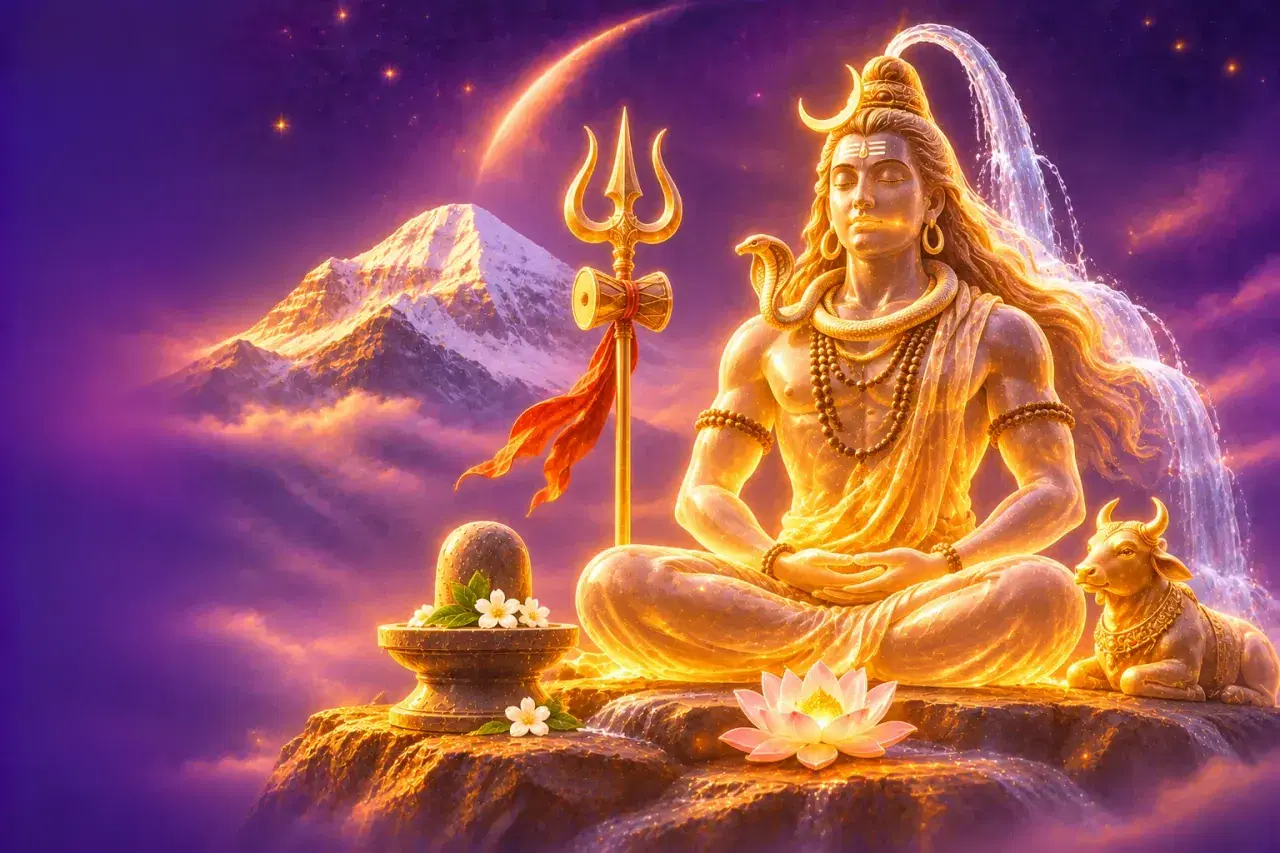
Shiva is perhaps the most paradoxical of the Hindu gods: an ascetic who is also a devoted husband, a destroyer who is also called Shankara, "the one who brings peace", a fearsome Rudra who is also Bholenath, "the innocent lord" who is easily pleased. Understanding his symbols is one of the best ways into the richness of Hindu thought.
Who Shiva is
- In the Trimurti, Shiva is the destroyer, or more precisely the transformer: the force that dissolves what has run its course so that creation can begin again.
- For Shaivas, Shiva is the supreme reality itself: creator, preserver and destroyer.
- As Adiyogi, the first yogi, he is the source of yoga and meditation.
- As a householder, he is the husband of Parvati and the father of Ganesha and Kartikeya. Read the story of Lord Ganesha for the best-loved family tale.
- In the Vedas, he appears as Rudra, the fierce god of storms, healing and the wild, praised in the Shri Rudram.
The meaning of Shiva's symbols
| Symbol | Traditional meaning |
|---|---|
| Third eye | Wisdom and inner vision. When it opened, it burned Kamadeva, the god of desire, to ashes: knowledge destroys blind desire |
| Crescent moon | Time, which Shiva wears as an ornament because he is beyond it. In one story he sheltered the Moon, who was wasting away under Daksha's curse |
| Ganga in his matted hair | When the river descended from heaven, only Shiva could break her fall; he caught her in his locks and released her gently to the earth |
| Matted hair (jata) | The ascetic and the wild, untamed power of nature |
| Serpent around the neck | Energy and fear brought under control; also kundalini, the coiled power within |
| Blue throat (Neelkantha) | He swallowed the poison halahala that rose from the churning of the ocean to protect the world; Parvati held his throat so it went no further |
| Trishul (trident) | The three gunas (sattva, rajas, tamas), or the three times (past, present, future), held in balance |
| Damaru (drum) | The rhythm of creation; from its sound, tradition says, came the Sanskrit sounds |
| Ash (vibhuti) | Impermanence: everything returns to ash |
| Tiger skin | Mastery over pride and desire |
| Rudraksha | "Rudra's eye"; tears of compassion, used in malas for japa |
| Nandi the bull | His mount and gatekeeper; patience, strength and devotion |
| Mount Kailash | His abode: stillness at the centre of the world |
The major forms of Shiva
| Form | What it shows |
|---|---|
| Nataraja | The lord of dance. In a ring of fire, he dances the cosmic dance of creation and dissolution, one foot raised, the other on the demon of ignorance. The bronze Nataraja of Chidambaram is world-famous |
| Ardhanarishvara | Half Shiva, half Parvati: the inseparability of masculine and feminine, consciousness and energy |
| Dakshinamurti | Shiva as the silent teacher, facing south, teaching through silence under a banyan tree |
| Lingam | The aniconic form: a column of light without beginning or end, worshipped in temples and homes |
| Bhairava | The fierce protector, guardian of sacred places such as Kashi |
| Pashupati | Lord of all beings; the great temple at Kathmandu |
| Mahakala | Lord of time and death, worshipped at Ujjain |
| Gangadhara | Bearer of the Ganga |
| Bholenath | The innocent, easily pleased lord of folk devotion |
The lingam
The Shiva lingam is the most common form of worship. The Shiva Purana tells how Brahma and Vishnu argued over who was greater, and an endless column of fire appeared between them. Neither could find its top or bottom. The column was Shiva, and the lingam represents that infinite light. Devotees offer water, milk, bel leaves and flowers to it, especially on Mondays.
The 12 Jyotirlingas
The twelve Jyotirlingas are shrines where Shiva is said to have manifested as a column of light. Visiting them is a lifelong pilgrimage for many devotees.
| Jyotirlinga | Location |
|---|---|
| Somnath | Gujarat |
| Mallikarjuna | Srisailam, Andhra Pradesh |
| Mahakaleshwar | Ujjain, Madhya Pradesh |
| Omkareshwar | Madhya Pradesh |
| Kedarnath | Uttarakhand |
| Bhimashankar | Maharashtra |
| Kashi Vishwanath | Varanasi, Uttar Pradesh |
| Trimbakeshwar | Nashik, Maharashtra |
| Vaidyanath | Deoghar, Jharkhand (some traditions name Parli, Maharashtra) |
| Nageshwar | Dwarka, Gujarat |
| Rameshwaram | Tamil Nadu |
| Grishneshwar | near Ellora, Maharashtra |
How Shiva is worshipped
- Mondays (Somvar): the weekly day of Shiva; many keep a Somvar fast.
- Pradosh: the twilight of the 13th lunar day, twice a month.
- Shravan month (July–August): the holiest month for Shiva, with the Kanwar Yatra in North India.
- Maha Shivaratri: the great night of Shiva, with fasting and worship through four prahars of the night. See the Maha Shivaratri page.
- Mantra: Om Namah Shivaya, the five-syllable Panchakshari mantra, and the Mahamrityunjaya mantra from the Rig Veda.
- Offerings: water, milk, bel (bilva) leaves, dhatura, bhasma and white flowers. Tulsi is offered to Vishnu, not usually to Shiva.