Before a wedding, a griha pravesh, an exam, a new business or even a new account book, Hindus first remember Ganesha. "Shri Ganeshaya Namah" begins countless letters and prayers. Few deities are as widely loved across India, by children and scholars alike. This guide brings together the main stories about Ganesha and what his unusual form is said to mean.
Who Ganesha is
Ganesha is the son of Shiva and Parvati, and the brother of Kartikeya (Murugan). He is honoured as:
- Vighnaharta, the remover of obstacles (and, in some texts, the placer of obstacles in the path of the unrighteous);
- the lord of beginnings, invoked at the start of every undertaking;
- the patron of wisdom, learning and the arts, and of writers and students;
- Ganapati, lord of the ganas, Shiva's attendants.
Two Puranas are devoted entirely to him, the Ganesha Purana and the Mudgala Purana, and a whole tradition of worship, the Ganapatya, regards him as the supreme deity.
The story of the elephant head
There are several versions. The most widely told comes from the Shiva Purana.
One day, while Shiva was away, Parvati wished to bathe undisturbed. From the turmeric paste on her body she shaped a boy, gave him life, and asked him to guard her door and let no one enter.
When Shiva returned, the boy, who had never seen him, blocked the way. Shiva's attendants could not move him, and in the fight that followed Shiva cut off the boy's head. Parvati's grief and anger shook the worlds. To console her, Shiva sent his attendants north with instructions to bring the head of the first living being they found. They returned with the head of an elephant, which Shiva placed on the boy's body, bringing him back to life.
Shiva then declared the boy his own son, made him the leader of his ganas, and decreed that he would be worshipped first, before any other god.
Another version
The Brahmavaivarta Purana tells it differently: at Ganesha's birth celebration, the planet-god Shani (Saturn), whose gaze was said to harm whatever it fell on, reluctantly looked at the child, and the baby's head was lost. Vishnu then brought an elephant's head to restore him. Different regions favour different versions; what they share is a child restored and raised above all.
Why Ganesha is worshipped first
Besides Shiva's boon, a much-loved story explains it. The gods once held a contest: whoever circled the universe first would be honoured first. Kartikeya set off at once on his peacock. Ganesha, whose mount is a small mouse, calmly walked around his parents, Shiva and Parvati, and said that for a child, his parents are the whole universe. Delighted, they declared him the winner. In some tellings the prize is a divine fruit; in Tamil tradition, Murugan's disappointment leads him to settle on the hill of Palani.
What his form means
Devotees and teachers often read each feature of Ganesha's form as a lesson:
| Feature | Traditional meaning |
|---|---|
| Large elephant head | Wisdom and intelligence |
| Big ears | Listen more |
| Small eyes | Concentration and focus |
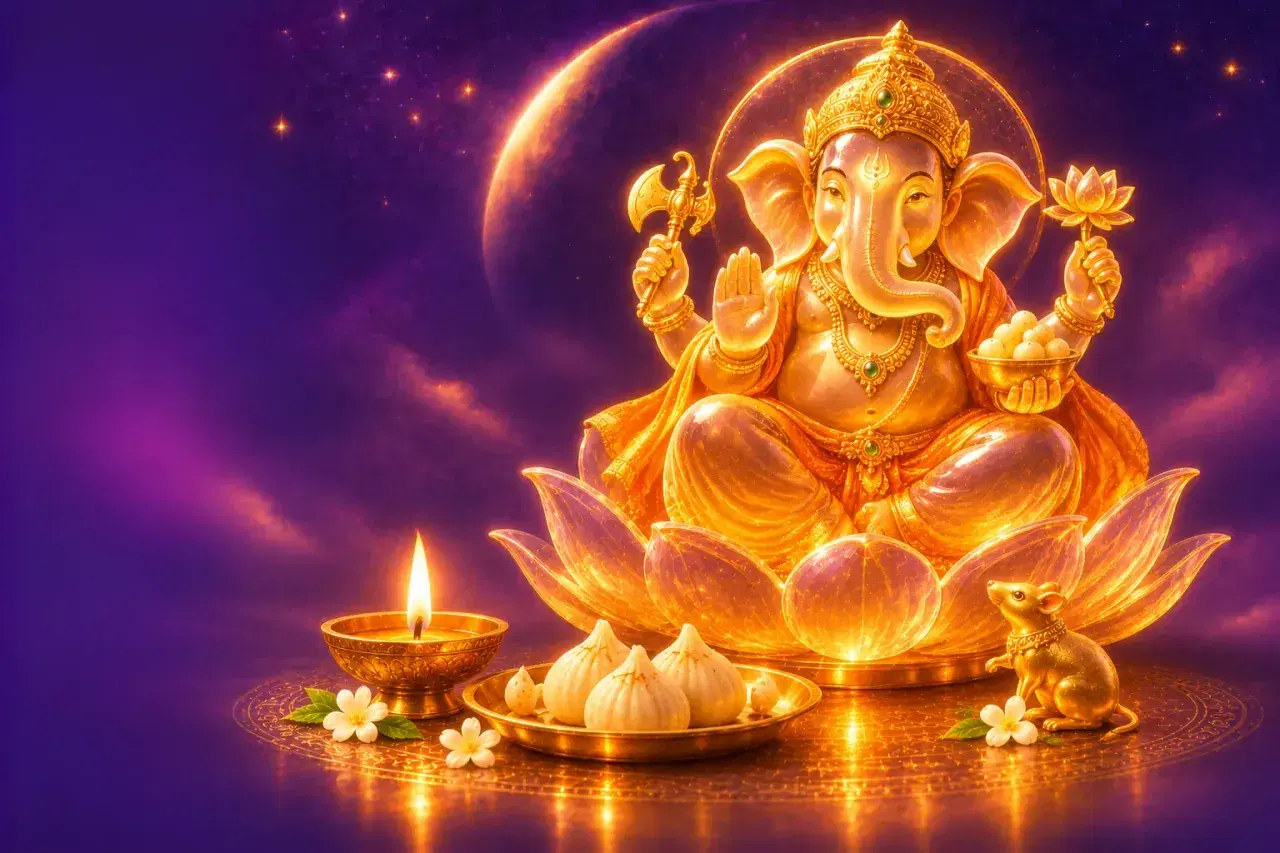
| Trunk | Adaptability: strong enough to uproot a tree, gentle enough to pick up a needle |
| Single tusk (Ekadanta) | Keeping the good and letting go of the rest; sacrifice for knowledge |
| Large belly | The capacity to digest all of life's experiences, good and bad |
| Modak in hand | The sweetness and reward of spiritual effort |
| Axe (parashu) | Cutting attachments |
| Noose (pasha) | Drawing the devotee closer to the goal |
| Raised hand (abhaya mudra) | "Do not fear" |
| The mouse (Mushika) | Desire and restless mind, brought under control |
The stories behind his names
Ganesha has many names, collected in hymns such as the Ganesha Sahasranama. A few with well-known stories:
| Name | Meaning | Story or reason |
|---|---|---|
| Ganapati / Ganesha | Lord of the ganas | Made leader of Shiva's attendants |
| Vinayaka | The supreme leader | One who has no leader above him |
| Vighneshvara | Lord of obstacles | Removes obstacles for the devoted |
| Ekadanta | One-tusked | In one telling he broke his tusk to keep writing the Mahabharata as Vyasa dictated it; in another, it was lost in a fight with Parashurama |
| Vakratunda | Curved trunk | Named in the popular prayer "Vakratunda Mahakaya…" |
| Lambodara | Pot-bellied | In one story his belly held the universe; in another, he ate so many modaks at a feast that his belly grew |
| Gajanana | Elephant-faced | From his elephant head |
| Sumukha | Pleasant-faced | His gentle, auspicious appearance |
Why we don't look at the Moon on Ganesh Chaturthi
A popular story says that once, as a well-fed Ganesha rode home on his mouse after a feast, he stumbled and his belly burst open. The Moon laughed. Ganesha cursed the Moon, and anyone who looked at it on that night, to suffer false blame. When the Moon repented, the curse was limited to the night of Bhadrapada Shukla Chaturthi. In the Bhagavata tradition, even Krishna was once falsely accused of stealing the Syamantaka jewel after glimpsing the Moon on that night. To this day, many families avoid looking at the Moon on Ganesh Chaturthi.
Festivals of Ganesha
| Festival | When | What happens |
|---|---|---|
| Ganesh Chaturthi | Bhadrapada Shukla Chaturthi (August–September) | Clay idols installed at home and in public pandals for 1½ to 10 days, then immersed (visarjan), most famously in Maharashtra |
| Sankashti Chaturthi | Every Krishna Chaturthi | A monthly fast broken after moonrise |
| Vinayaka Chaturthi | Every Shukla Chaturthi | A monthly day of Ganesha worship |
| Ganesh Jayanti (Maghi Ganeshotsav) | Magha Shukla Chaturthi | Observed especially in Maharashtra and Goa |
You can find the dates for your city on our Ganesh Chaturthi page and in the Panchang.
Ganesha across India and beyond
In Maharashtra, the eight Ashtavinayaka shrines are a famous pilgrimage circuit. In Mumbai, Siddhivinayak is one of the most visited temples in the country. In much of North and West India Ganesha is shown with his consorts Riddhi (prosperity) and Siddhi (spiritual attainment); in many South Indian traditions he is a bachelor. His image appears far beyond India too, in Nepal, Sri Lanka, Thailand, Indonesia and Japan.