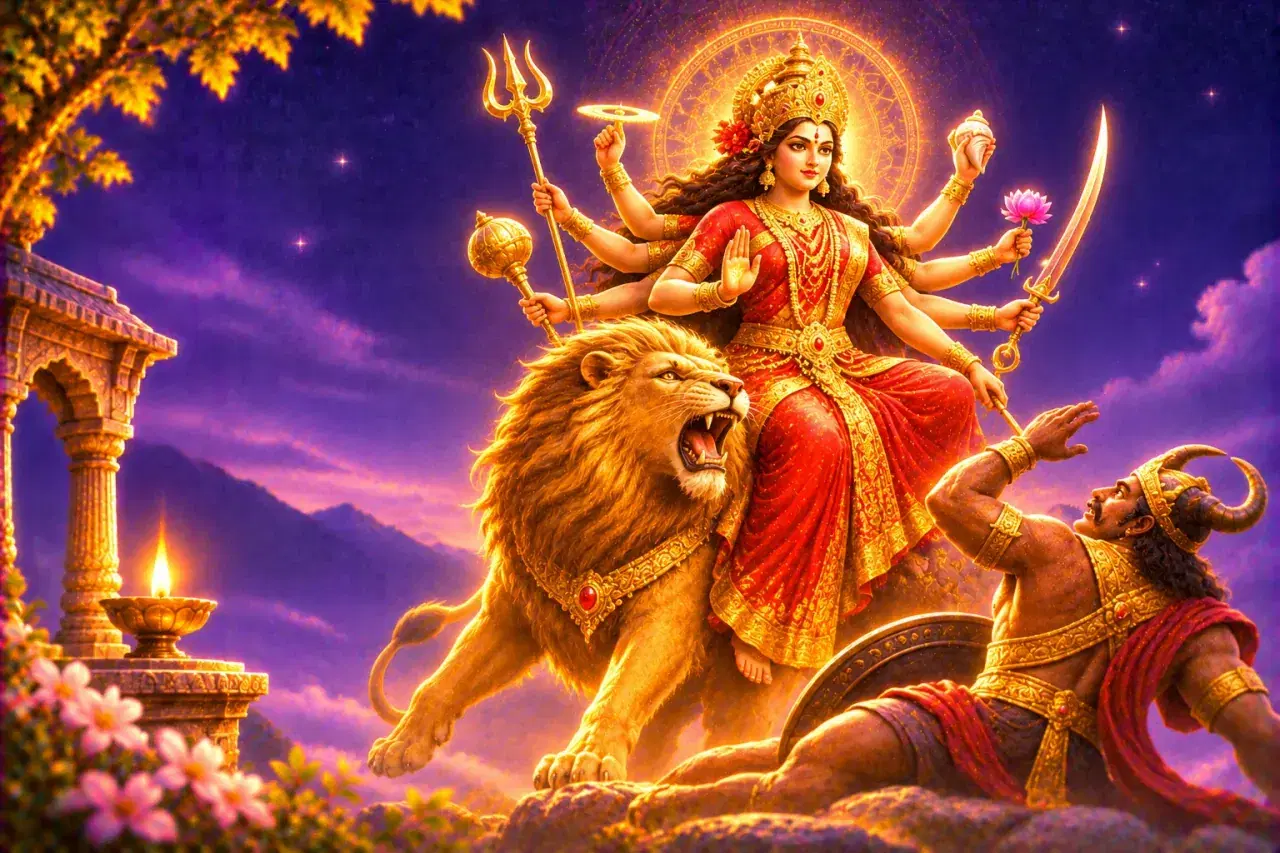
Every autumn, from Kolkata's pandals to Gujarat's garba grounds, India celebrates a goddess riding a lion with ten arms, each holding a weapon, as she slays a buffalo demon. This is Durga, and the story behind her is one of the most powerful in Hindu tradition: the triumph of the divine feminine over arrogance and evil.
The source: the Devi Mahatmya
The story is told in the Devi Mahatmya ("Glory of the Goddess"), also called the Durga Saptashati or Chandi Path, 700 verses in thirteen chapters forming part of the Markandeya Purana. It is recited in full during Navratri in many homes and temples. It contains three great episodes; the second, the defeat of Mahishasura, is the most famous.
Mahishasura's boon
Mahishasura was an asura who could take the form of a buffalo (mahisha). Through fierce austerities he pleased Brahma and asked for immortality. Refused, he asked instead that no man and no god should be able to kill him, never imagining that a woman could defeat him. Granted his boon, he attacked the heavens, defeated Indra and the gods, and took their places.
The birth of Durga
The defeated gods went to Brahma, Vishnu and Shiva. As they heard what had happened, their anger blazed out as light. From Vishnu, Shiva, Brahma, Indra and all the gods poured streams of radiance that merged into a single mountain of light, and from it arose a goddess of unbearable brilliance: Durga, "the invincible", "the one who is hard to approach".
Her weapons and gifts
Each god gave her his own power:
| Gift | Given by | Traditional meaning |
|---|---|---|
| Trident (trishul) | Shiva | Mastery of the three gunas; destruction of evil |
| Discus (sudarshana chakra) | Vishnu | Righteousness and the order of the universe |
| Conch | Varuna | The sacred sound; victory |
| Thunderbolt (vajra) | Indra | Firmness of spirit |
| Bow and arrows | Vayu (and Surya, in some tellings) | Focused energy |
| Sword | Kala (Time) | Knowledge that cuts through ignorance |
| Spear | Agni | Fiery power |
| Lotus | Brahma (with his water-pot) | Purity, detachment |
| Lion | Himavat (the Himalaya) | Courage and dharma, her mount |
Ornaments, garlands and jewels came from the other gods, and the ocean gave her garments.
The battle
Durga's laughter shook the three worlds. Mahishasura sent his generals and armies against her, and one by one she destroyed them: Chikshura, Chamara, Udagra, Bashkala and many more. Mahishasura himself came at her, changing shape again and again: a buffalo, a lion, a man with a sword, an elephant, and the buffalo once more. The battle lasted nine days and nights.
At last, as the demon was emerging from the buffalo's body in his true form, Durga pinned the buffalo with her foot, pierced him with her trident and beheaded him with her sword. The gods praised her as Mahishasura Mardini, "slayer of Mahishasura". The hymn Aigiri Nandini, attributed to Adi Shankaracharya, sings this victory.
What the story means
- Ego and ignorance: Mahishasura, who changes form endlessly, is often read as the restless, arrogant ego; Durga, the clear, unified power of consciousness, overcomes it.
- Shakti: the story expresses the Shakta view that the divine feminine is the active power of the universe, the energy without which even the gods cannot act.
- Unity: Durga is born from the combined power of all the gods: united strength overcomes what divided strength could not.
- The boon's loophole: pride in one's own invulnerability is the weakness that brings the fall.
Festivals of Durga
| Festival | What happens |
|---|---|
| Sharad Navratri | Nine nights of worship of the Goddess in her nine forms (Navadurga), with fasting and garba. See Sharad Navratri |
| Durga Puja | In Bengal, Odisha, Assam and Bihar, five days of worship of Durga with her children Lakshmi, Saraswati, Ganesha and Kartikeya, in pandals |
| Durga Ashtami | The eighth day, with Kanya Pujan (worship of young girls as the Goddess). See Durga Ashtami |
| Vijayadashami (Dussehra) | The tenth day: Durga's victory over Mahishasura, and Rama's over Ravana |
| Chaitra Navratri | The spring Navratri |
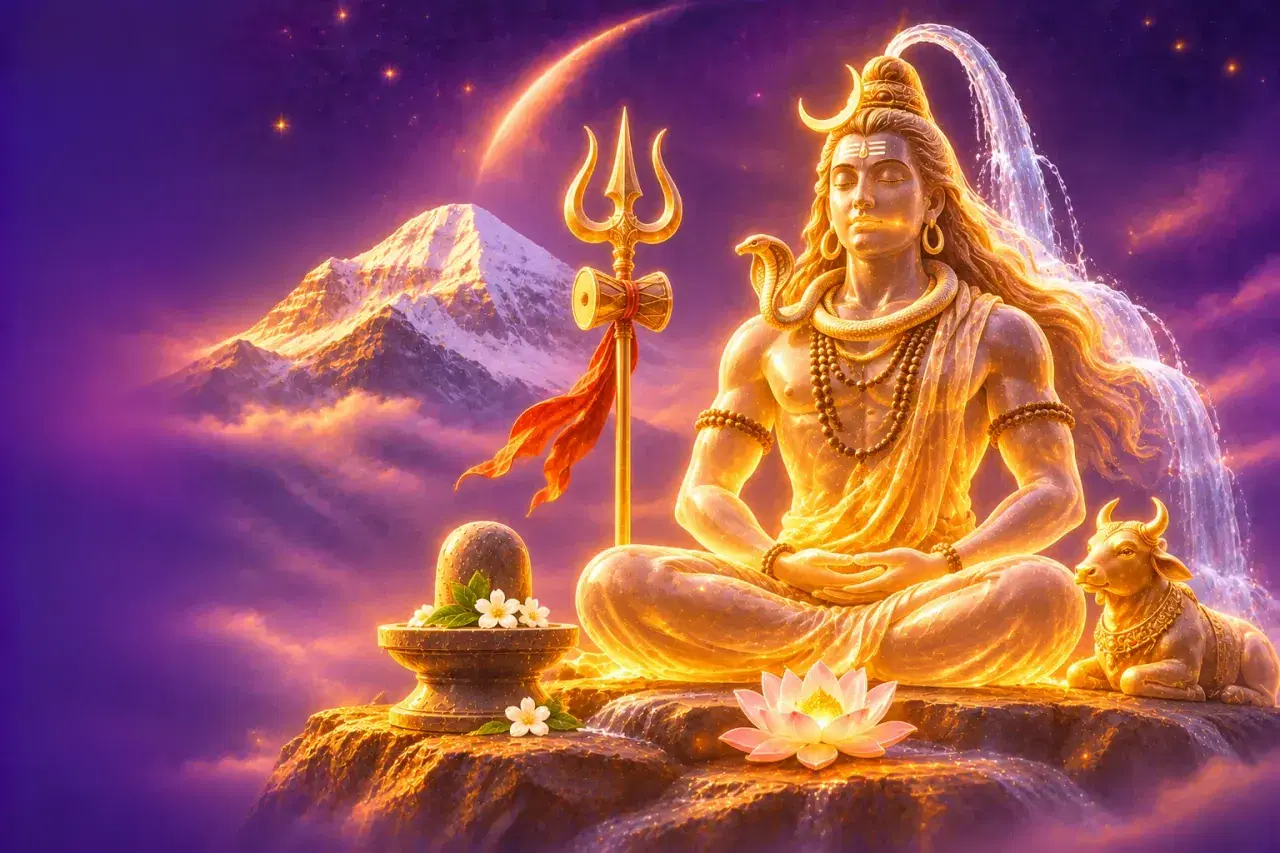
In Bengal's tradition, Durga's autumn visit is her homecoming to her parents' house, with her children, before she returns to Shiva on Kailash, which is why Vijayadashami there is both joyful and tearful. Durga is understood as a form of Parvati, Shiva's consort; see Lord Shiva.