In temples across India, often at the edge of a village or on a hilltop, stands an image of Hanuman: orange with sindoor, a mace in hand, sometimes carrying a mountain. Children recite the Hanuman Chalisa before exams; wrestlers bow to him in the akhara; truck drivers paint his image on their cabins. Here are the stories behind the devotion.
Birth and parentage
Hanuman was born to Anjana, a celestial woman (apsara) living on earth under a curse, and Kesari, a vanara chief. He is also called the son of Vayu, the wind god, who carried divine blessing to Anjana. Some traditions describe him as an incarnation (ansha) of Shiva. His names reflect this: Anjaneya (son of Anjana), Kesari Nandan (son of Kesari) and Pavanputra or Maruti (son of the wind).
The child who leapt at the Sun
As a hungry infant, Hanuman saw the rising Sun and thought it was a ripe fruit. He leapt into the sky to eat it. Alarmed, Indra struck him with his thunderbolt (vajra), and the child fell to earth with an injured jaw. In Sanskrit, hanu means jaw, and so he came to be called Hanuman.
Furious at the harm done to his son, Vayu withdrew all air from the world, and every creature began to suffocate. The gods hurried to appease him. They revived the child and showered him with boons: invulnerability to weapons, fire and water, immense strength, the ability to change his size at will, and long life.
The curse of forgetting
The young Hanuman, with all his new powers, became a mischievous child, disturbing sages at their meditation. A group of sages cursed him to forget his powers until someone reminded him of them at the right moment. This is why, many years later, he needed reminding before his greatest deed.
Learning from the Sun
Hanuman asked Surya, the Sun god, to be his teacher. Since Surya never stops moving across the sky, Hanuman flew alongside his chariot, facing him, and learned all the scriptures as they travelled, in one telling within sixty hours. He then offered Surya his service as guru dakshina.
Meeting Rama
In the Kishkindha Kanda of the Ramayana, Hanuman was the minister of the exiled vanara king Sugriva. When two princes appeared in the forest, Sugriva sent Hanuman, disguised as a Brahmin, to find out who they were. They were Rama and Lakshmana, searching for Sita. From that moment, Hanuman's life became devotion to Rama. For the whole epic, see the Ramayana in brief.
The leap to Lanka
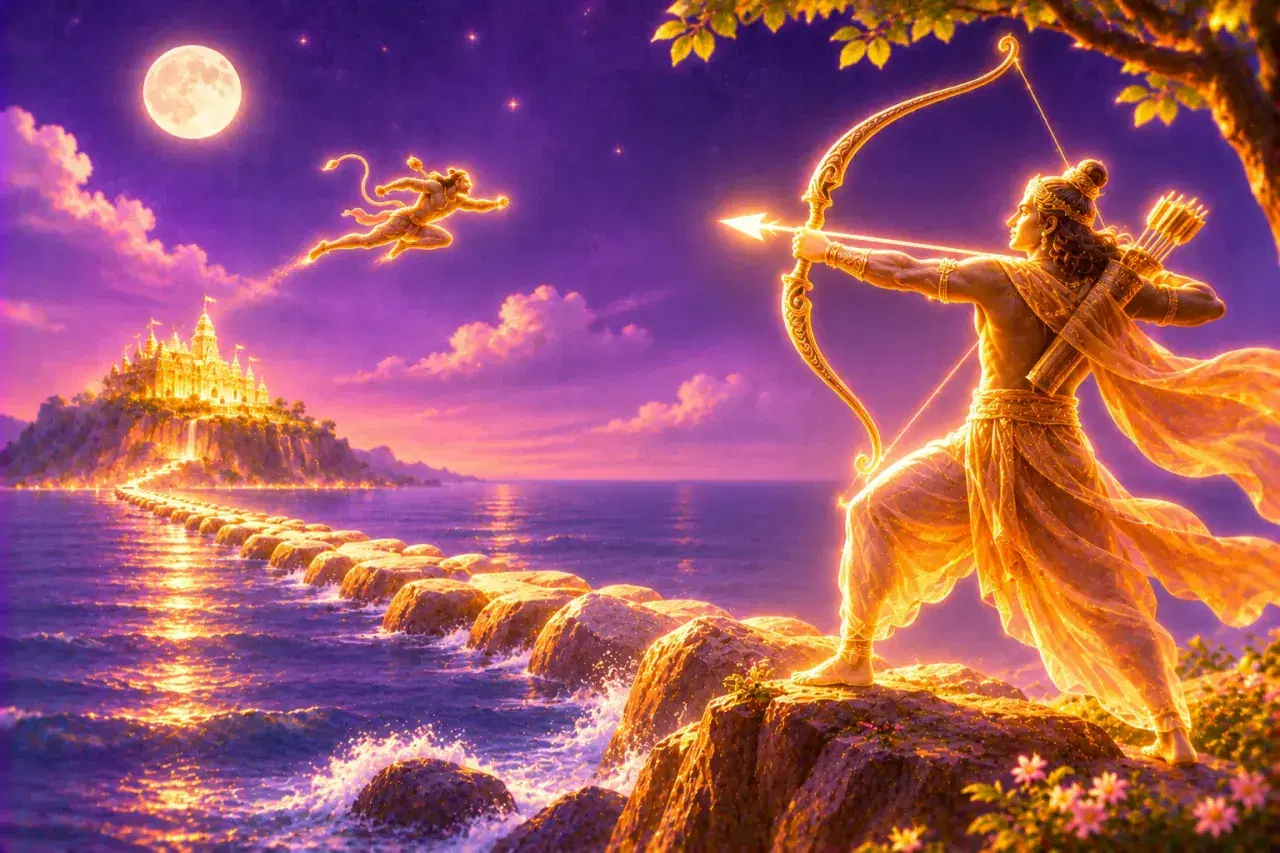
When the search parties reached the southern ocean, no one knew how to cross it. The wise old bear Jambavan reminded Hanuman of who he was and what he could do. The curse lifted. Hanuman grew to an enormous size and leapt across the ocean. On the way he outwitted Surasa, the mother of serpents, by growing huge and then shrinking to the size of a thumb to pass through her mouth, and defeated Simhika, a demoness who seized flyers by their shadows.
In Lanka he searched for Sita and found her in the Ashoka grove, steadfast despite Ravana's threats. He gave her Rama's ring and comforted her.
Lanka on fire
To see Ravana's court, Hanuman let himself be captured. When Ravana ordered his tail set on fire as punishment, Hanuman grew his tail longer and longer as they wrapped it in oil-soaked cloth, then broke free and leapt from roof to roof, setting Lanka ablaze, before dousing his tail in the sea and returning to Rama with news of Sita. The Sundara Kanda, which tells this, is so loved that many devotees read it on its own.
The Sanjivani mountain
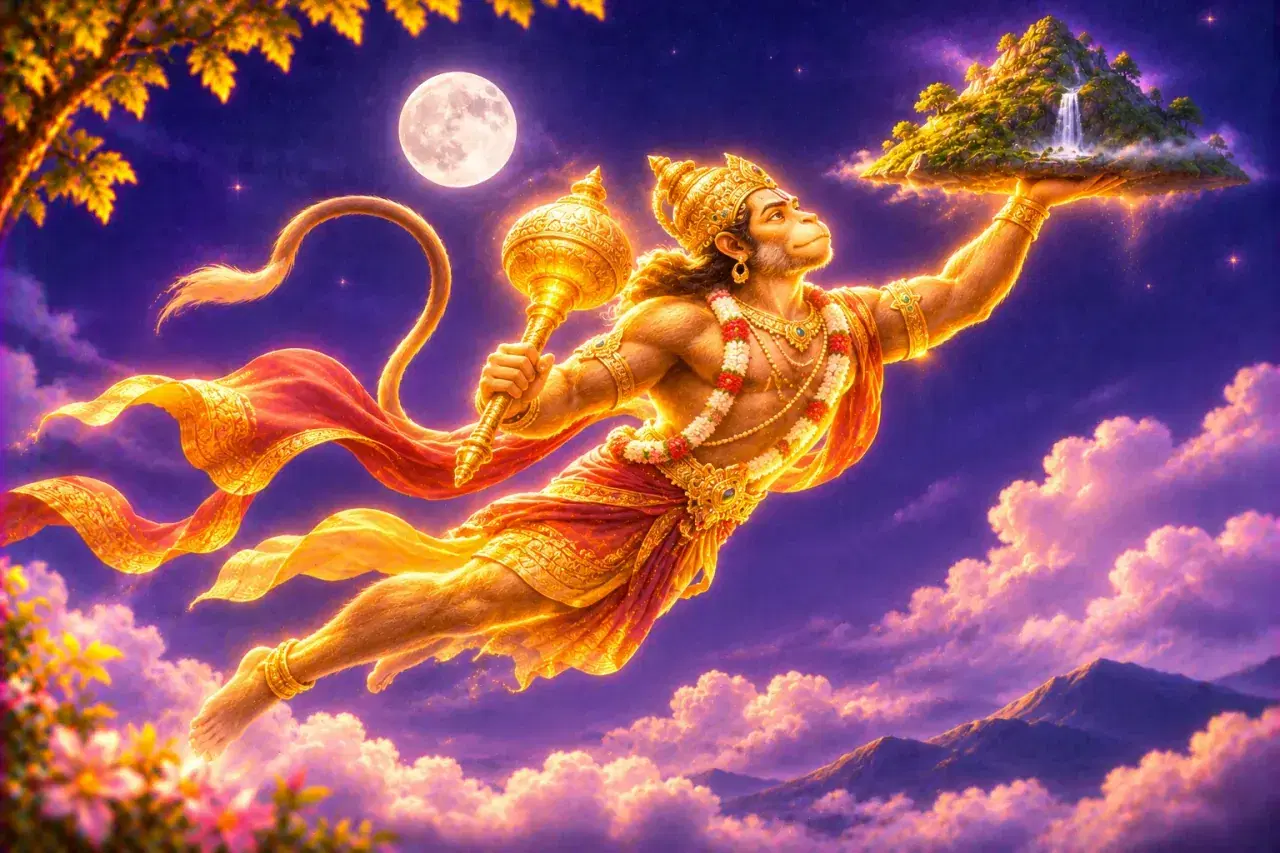
During the war, Lakshmana was struck down. The physician Sushena said only the sanjivani herb from a Himalayan mountain could save him, before sunrise. Hanuman flew north, but could not tell which plant was the right one, so he lifted the whole mountain and carried it back. Lakshmana was healed. This image, Hanuman flying with a mountain in his hand, is one of the most famous in Indian art.
Devotion beyond measure
After the war, Sita gave Hanuman a pearl necklace. He began biting the pearls one by one. When asked why, he said he was looking for Rama and Sita inside them, and anything without Rama had no value to him. Popular tradition adds that, to prove it, he tore open his chest to show Rama and Sita in his heart, an image found in countless calendar prints and temples.
Hanuman in the Mahabharata
Hanuman also appears in the Mahabharata. During the Pandavas' exile, Bhima, proud of his strength, found an old monkey lying across his path and told it to move its tail. The monkey asked him to move it himself. Bhima could not lift it at all. The monkey revealed himself as Hanuman, Bhima's elder brother (both are sons of Vayu), and blessed him. During the Kurukshetra war, Hanuman rode on the flag of Arjuna's chariot.
Why Hanuman is immortal
Hanuman is one of the chiranjivis, beings said to live until the end of the age. Tradition holds that he chose to stay on earth as long as Rama's story is told, which is why many believe he is present wherever the Ramayana is recited.
Worship of Hanuman
| Practice | Detail |
|---|---|
| Days | Tuesday and Saturday |
| Prayer | The Hanuman Chalisa by Tulsidas; the Sundara Kanda; the Bajrang Baan |
| Offerings | Sindoor and jasmine oil, boondi or besan laddoo, red flowers, tulsi garlands |
| Festival | Hanuman Jayanti: on Chaitra Purnima in most of North India; on other dates in Tamil Nadu, Kerala, Andhra Pradesh and Karnataka. See Hanuman Jayanti |
A popular story says Hanuman once freed Shani (Saturn) from Ravana's captivity, and Shani promised not to trouble Hanuman's devotees, which is why many people pray to Hanuman on Saturdays.