The Ramayana is more than a story. Over two thousand years it has been retold in Sanskrit, Tamil, Awadhi, Bengali, Thai, Javanese and countless folk forms; it lives in Ram Lila performances, in Diwali lamps and in everyday sayings. Its hero, Rama, is honoured as maryada purushottama, the ideal person who never strays from dharma. Here is the whole story, book by book.
The seven kandas at a glance
| Kanda (book) | What happens |
|---|---|
| Bala Kanda | Rama's birth and youth; Sita's swayamvara and the wedding |
| Ayodhya Kanda | Rama's exile on the eve of his coronation |
| Aranya Kanda | Life in the forest; Sita's abduction by Ravana |
| Kishkindha Kanda | Alliance with Sugriva and Hanuman; the search begins |
| Sundara Kanda | Hanuman's leap to Lanka and his meeting with Sita |
| Yuddha Kanda | The bridge, the war, Ravana's defeat, the return to Ayodhya |
| Uttara Kanda | Rama's reign and the later life of Sita (regarded by many scholars as a later addition) |
1. Bala Kanda: childhood and wedding
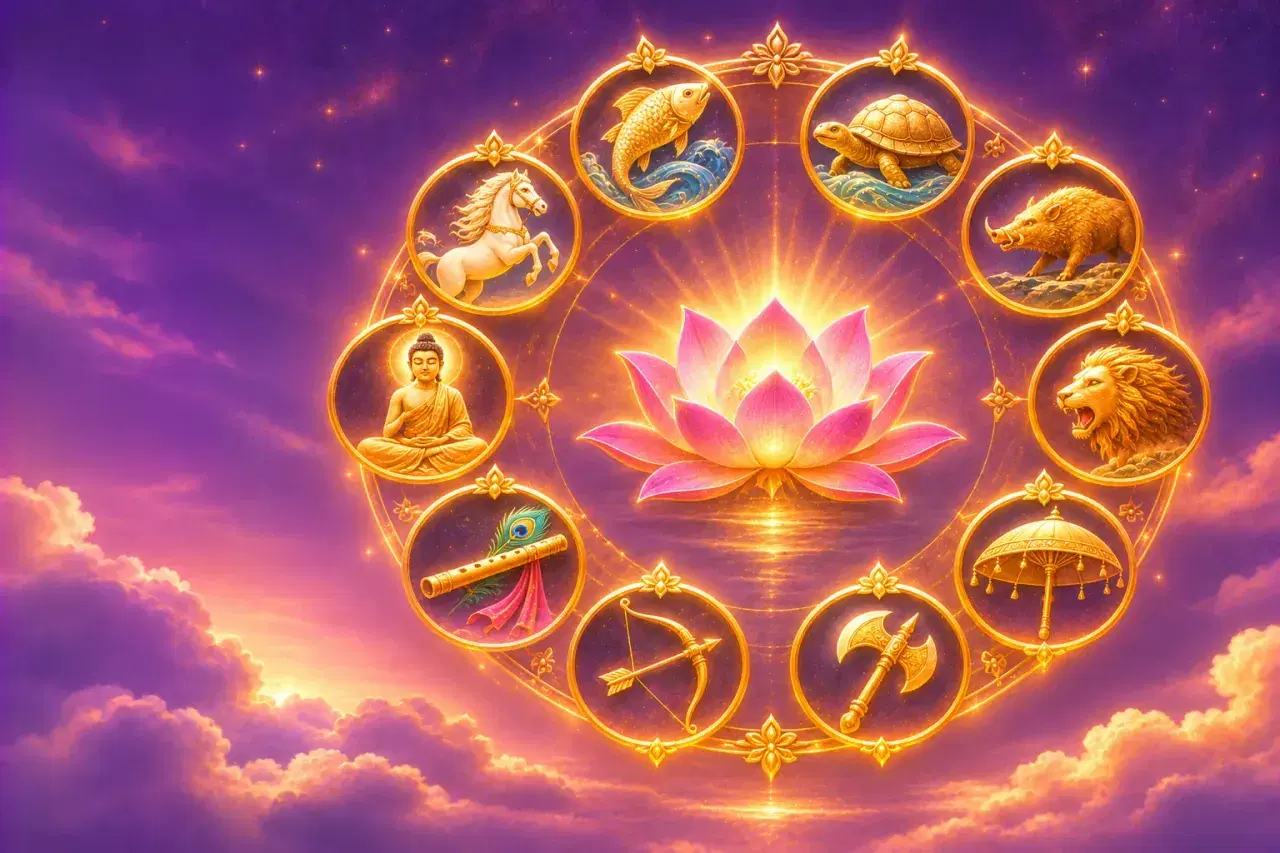
King Dasharatha of Ayodhya had three queens, Kaushalya, Kaikeyi and Sumitra, but no heir. After a great sacrifice, four sons were born: Rama (to Kaushalya), Bharata (to Kaikeyi), and the twins Lakshmana and Shatrughna (to Sumitra). Rama, an avatar of Vishnu (see the Dashavatara), grew up brave, gentle and devoted to dharma, with Lakshmana always at his side.
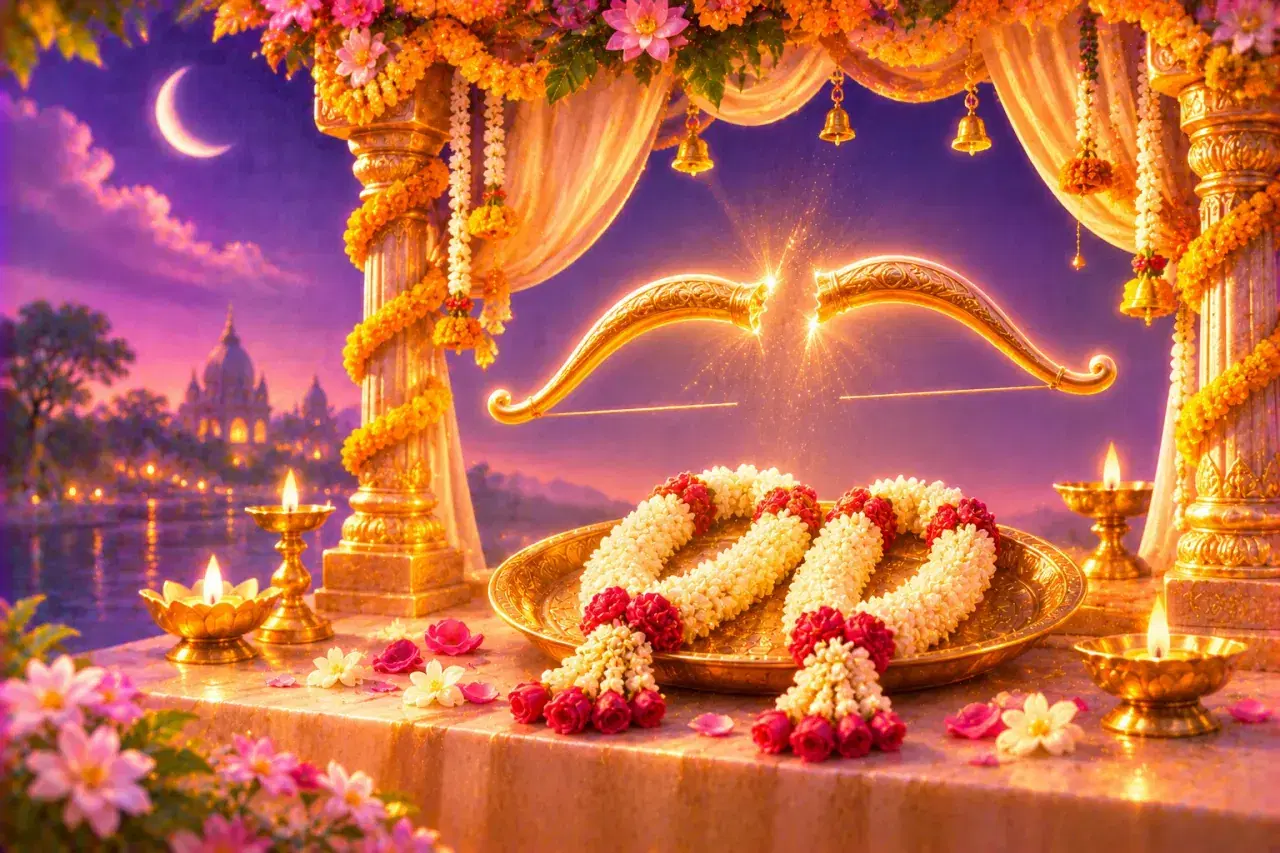
The sage Vishvamitra took the young Rama and Lakshmana to protect his sacrifices from demons. He then led them to Mithila, where King Janaka had promised his daughter Sita to whoever could string the bow of Shiva. Rama lifted and broke it, and the four brothers were married to Sita and her sisters and cousins. Our guide to Vivah Panchami tells this part in detail.
2. Ayodhya Kanda: the exile
Dasharatha decided to crown Rama. But Queen Kaikeyi, urged by her maid Manthara, reminded the king of two boons he had once promised her. She asked that Bharata be crowned and that Rama be exiled to the forest for fourteen years. Bound by his word, the king agreed, heartbroken.
Rama accepted without anger. Sita insisted on going with him, and Lakshmana refused to be left behind. Soon after, Dasharatha died of grief. Bharata, horrified, went to the forest to bring Rama back; when Rama refused to break his father's word, Bharata carried Rama's sandals back to Ayodhya, placed them on the throne, and ruled only as Rama's regent.
3. Aranya Kanda: the forest and the abduction
Rama, Sita and Lakshmana lived simply in the forests of Dandaka and later at Panchavati, meeting sages and protecting them from demons. The demoness Shurpanakha, sister of Ravana, king of Lanka, tried to win Rama and then attack Sita; Lakshmana cut off her nose.
Seeking revenge, Ravana sent the demon Maricha disguised as a golden deer. Sita longed for it; Rama chased it; Maricha, dying, cried out in Rama's voice. Sita urged Lakshmana to go help. Before leaving, in many retellings, Lakshmana drew a protective line, the Lakshman rekha. Ravana arrived disguised as a wandering ascetic, and when Sita stepped out to give him alms, he seized her and flew south in his chariot. The old vulture Jatayu fought him and was fatally wounded; dying, he told Rama which way Ravana had gone. On the way, Rama also met the devoted forest woman Shabari, who offered him berries she had tasted first to make sure they were sweet.
4. Kishkindha Kanda: allies
In the land of Kishkindha, Rama met Hanuman, minister to the exiled vanara king Sugriva. Rama helped Sugriva defeat his brother Vali and regain his kingdom; in return Sugriva sent vanara search parties in every direction. Hanuman's group reached the southern shore, where Jatayu's brother Sampati saw Sita far across the sea in Lanka.
5. Sundara Kanda: Hanuman's leap
Reminded of his forgotten powers, Hanuman grew to an immense size and leapt across the ocean to Lanka. He found Sita in the Ashoka grove, refusing Ravana's threats and offers, and gave her Rama's ring as a sign. Then he let himself be captured to see Ravana's court, and when the demons set his tail on fire, he leapt from roof to roof and set Lanka ablaze, before returning with news for Rama. The Sundara Kanda is so loved that many people read it on its own as a devotional practice.
6. Yuddha Kanda: the war
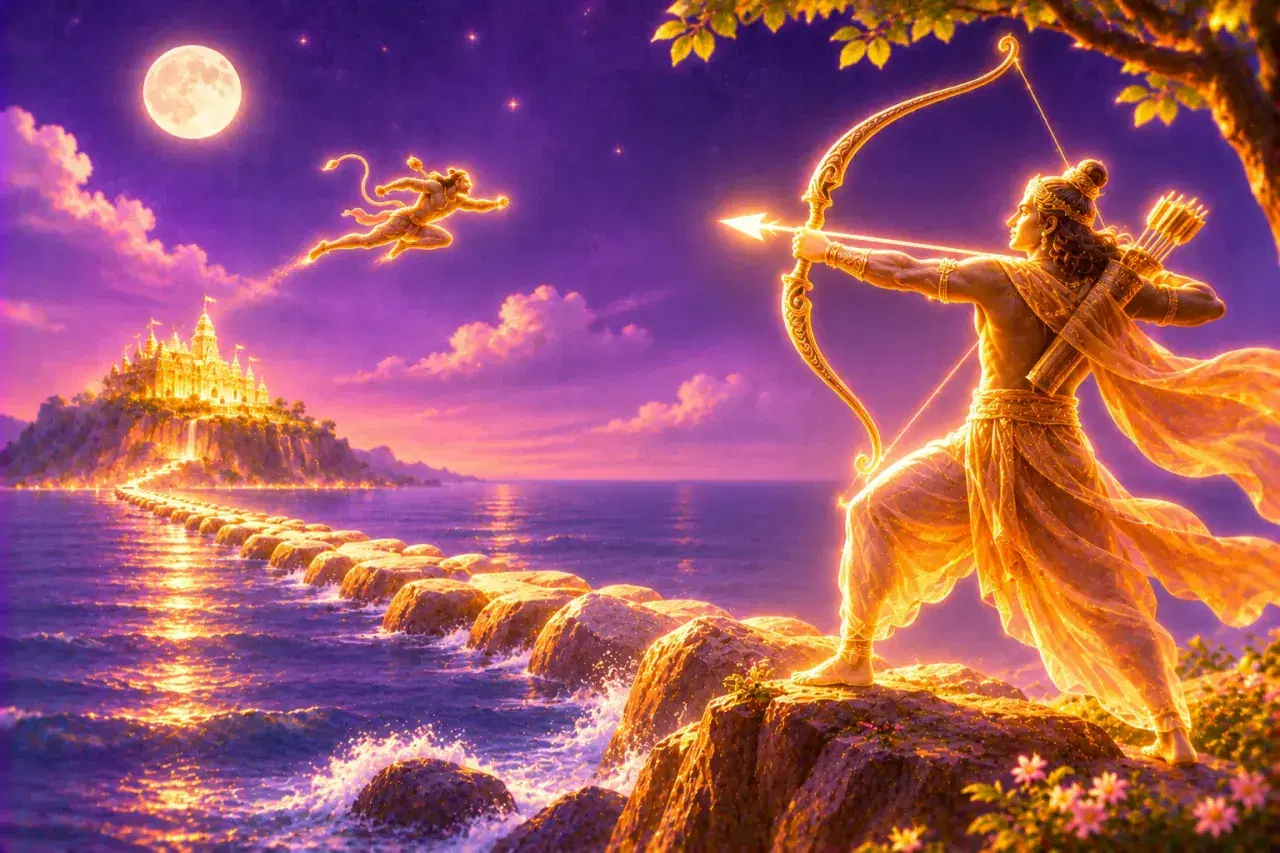
The vanara army built a bridge of floating stones across the sea, the Rama Setu. Ravana's own brother Vibhishana, who had urged him to return Sita, came over to Rama's side. A great war followed. Ravana's giant brother Kumbhakarna and his son Indrajit (Meghanada) fell. When Lakshmana was struck down, Hanuman flew to the Himalayas for the healing sanjivani herb and, unable to identify it, brought back the whole mountain.
Finally Rama faced Ravana, the ten-headed king, and killed him with a divine arrow. Dussehra (Vijayadashami) celebrates this victory of good over evil.
Sita was reunited with Rama. In Valmiki's telling she proved her purity through the agni pariksha, walking through fire unharmed. The exile complete, Rama, Sita, Lakshmana and Hanuman returned to Ayodhya, where the people lit rows of lamps to welcome them: the first Diwali. Rama was crowned, and his reign, Ram Rajya, became the byword for just and happy rule.
7. Uttara Kanda: the later story
The Uttara Kanda tells how, because of rumours among his people, Rama sent the pregnant Sita away. She lived in the hermitage of Valmiki, where her twin sons Lava and Kusha were born and learned the Ramayana itself. When they sang it at Rama's court, father and sons were reunited, but Sita, asked once more to prove her purity, called on her mother the Earth, who opened and took her home. Many scholars regard this book as a later addition, and many retellings, including Tulsidas's Ramcharitmanas, treat it differently or end with the coronation.
The Ramayana's many versions
- Valmiki Ramayana (Sanskrit): the adi kavya, the first poem.
- Ramcharitmanas by Tulsidas (Awadhi, 16th century): the best-loved telling in North India.
- Kamba Ramayanam by Kamban (Tamil): a classic of Tamil literature.
- Krittivasi Ramayan (Bengali), Ramakien (Thailand), Kakawin Ramayana (Java) and hundreds of folk versions.
Festivals of the Ramayana
| Festival | Remembers |
|---|---|
| Ram Navami | Rama's birth. See Ram Navami |
| Vivah Panchami | Rama and Sita's wedding |
| Dussehra | Rama's victory over Ravana |
| Diwali | Rama's return to Ayodhya. See Diwali |
| Hanuman Jayanti | Hanuman's birth |