In many Indian homes, the tulsi plant in the courtyard is treated as a member of the family. Once a year, at the end of the monsoon months, she is dressed as a bride and married to Lord Vishnu with full wedding rites, music and sweets. This is Tulsi Vivah, one of the most charming festivals of the year, and the traditional start of the wedding season.
When Tulsi Vivah is performed
Tulsi Vivah follows Dev Uthani (Prabodhini) Ekadashi, the day Vishnu is said to wake from his four-month sleep. Families follow one of three customs:
| Custom | Day in 2026 |
|---|---|
| On Dev Uthani Ekadashi itself | Friday 20 November 2026 |
| On Dvadashi, the next day (very common) | Saturday 21 November 2026 |
| Any day from Ekadashi to Kartik Purnima | 20–24 November 2026 |
Dates follow the sunrise tithi for Delhi; check the Ekadashi page for your city. For the story of Vishnu's awakening, read our guide to Dev Uthani Ekadashi.
The story of Vrinda and Jalandhara
Like many puranic stories, this one is told in more than one way, in texts such as the Shiva Purana and the Padma Purana and in countless folk retellings. The outline is shared.
Jalandhara was a mighty asura, born, in one telling, from the fire of Shiva's third eye when it was cast into the ocean. He grew so powerful that he conquered the heavens. His strength had a secret source: his wife Vrinda, a devoted follower of Vishnu, whose purity and devotion to her husband (her pativrata) made him invincible.
When Jalandhara went to battle against Shiva himself, the gods knew he could not be defeated while Vrinda's vow remained unbroken. Vishnu took on Jalandhara's form and appeared before Vrinda, who welcomed him as her husband. In that moment her vow was broken, and on the battlefield Shiva was finally able to slay Jalandhara.
When Vrinda realised what had happened, she cursed Vishnu to become a lifeless stone, the Shaligram. Her grief was so great that she gave up her life. Moved by her devotion, Vishnu blessed her: she would be reborn as the tulsi plant, more sacred to him than any other, and he would marry her every year. No worship of Vishnu would be complete without a tulsi leaf.
What the story is taken to mean
Devotees read the story as a tribute to Vrinda's devotion and as an acknowledgement, even by the gods, of the wrong done to her. That is why tulsi is honoured above every other plant in Vishnu worship, and why her wedding is celebrated with such affection. Tulsi Vivah is also seen as the first marriage after Chaturmas: once Tulsi is married, human weddings can begin.
Why tulsi is sacred
Beyond the story, tulsi has long been revered in Indian homes. Its leaves are offered in Vishnu and Krishna worship, placed in charanamrit, and strung into malas for japa. Watering the tulsi and lighting a lamp before her each evening, especially through the month of Kartik, is a daily practice in many households. Tulsi also has a long history in Ayurveda, though that is separate from its religious role.
Tulsi Vivah samagri (what you need)
| Item | Use |
|---|---|
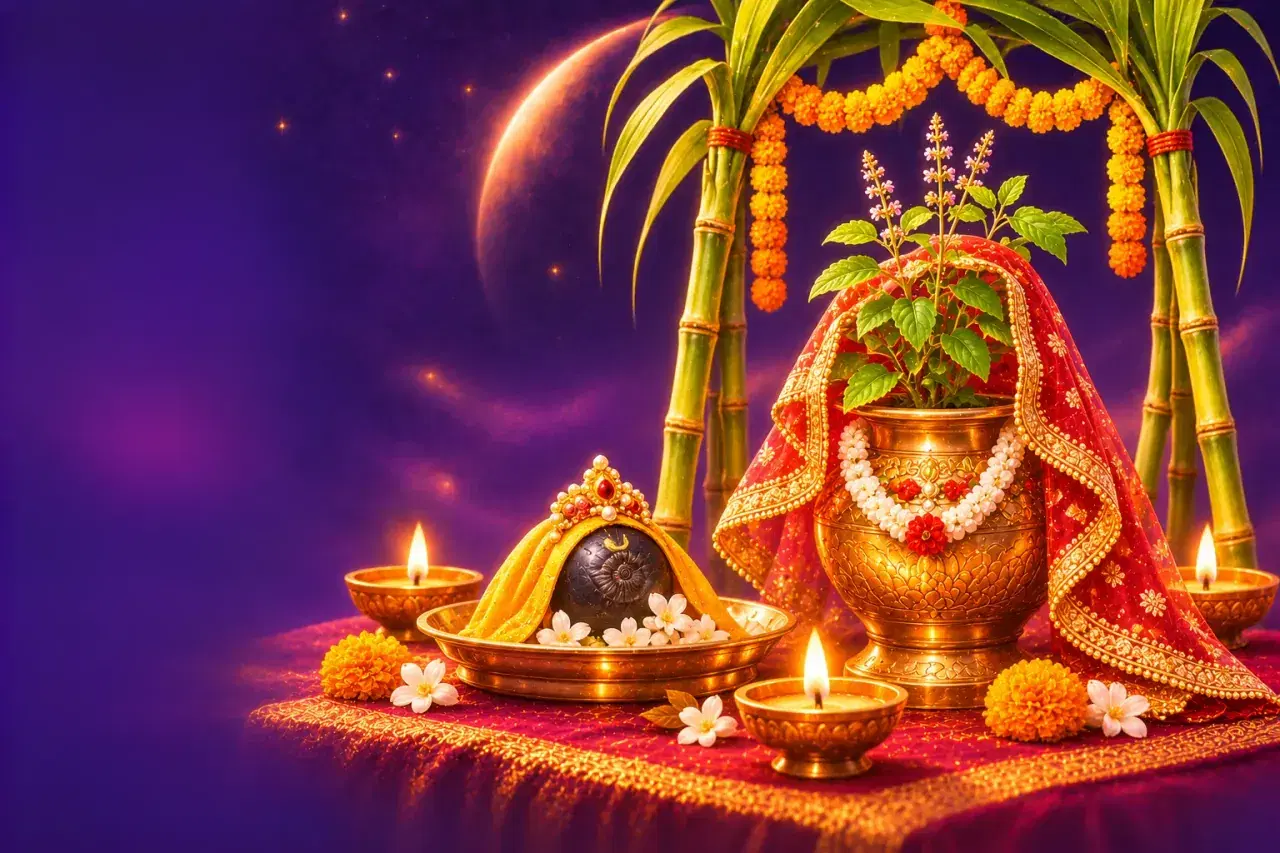
| Tulsi plant in a pot, cleaned and decorated | The bride |
| Shaligram stone, or an idol or picture of Vishnu or Krishna | The groom |
| Sugarcane stalks (4) | To build the wedding canopy (mandap) |
| Red chunari or small sari, bangles, bindi, sindoor, mehendi | Bridal adornment for Tulsi |
| Yellow cloth or dhoti, janeu (sacred thread) | For the groom |
| Flowers, garlands, haldi, kumkum, sandalwood paste, akshat (rice) | Worship |
| Ghee lamp, incense, camphor for aarti | Worship |
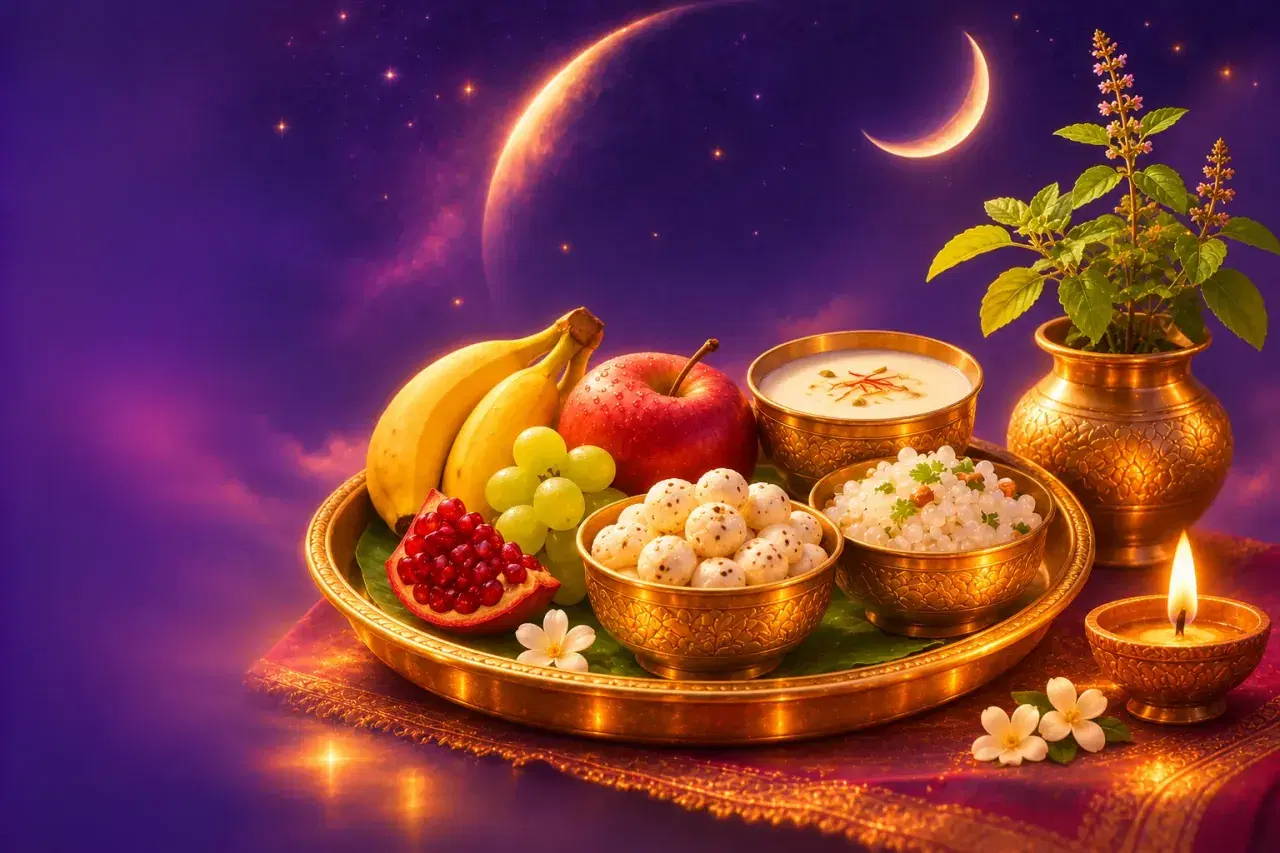
| Seasonal offerings: sugarcane, singhara, sweet potato, ber, amla, fruits, sweets | Bhog |
| Kalash with water, mango leaves and a coconut | Ritual pot |
Puja vidhi: a simple home ceremony
Families perform Tulsi Vivah with as much or as little elaboration as they like; some invite a priest, many simply follow these steps together with songs.
- Prepare the space. Clean the area around the tulsi in the evening. Draw a rangoli and place the pot on a raised platform.
- Build the mandap. Tie four sugarcane stalks over the pot to form a canopy and decorate it with flowers and mango leaves.
- Dress the bride. Wrap Tulsi in the red chunari, adorn her with bangles and a bindi, and apply haldi and kumkum to the pot.
- Prepare the groom. Bathe the Shaligram (or idol) with water or panchamrit, dress it in yellow cloth and place it beside the tulsi, usually on the right.
- Ganesh puja and sankalpa. Begin, as with every ritual, by remembering Lord Ganesha, then state your intention to perform Tulsi Vivah.
- Worship both. Offer water, sandalwood paste, flowers, akshat, incense and a lamp, chanting a Vishnu mantra such as Om Namo Bhagavate Vasudevaya.
- Kanyadaan. The family members who "give away" the bride, often the couple of the house, hold the tulsi's hand (a leaf or the pot) and offer her to the groom.
- Saat phere. Carry the Shaligram around the tulsi seven times, or move the tulsi pot around the groom, while family members sing wedding songs.
- Tie the knot. Join a thread or a cloth between the two as the wedding knot, and shower akshat and flowers.
- Aarti and bhog. Perform aarti, offer the seasonal produce and sweets, and distribute prasad.
Many families also keep a light fast until the ceremony is done, following the Ekadashi vrat rules.
Regional traditions
- Maharashtra and Gujarat: Tulsi Vivah is a festive community event, with the tulsi courtyard (vrindavan) painted and lit, and mangalashtak sung as at a human wedding.
- Uttar Pradesh and Bihar: combined with the Dev Uthani customs of drawing the gods' feet and covering seasonal produce with a sieve.
- Temples: many Vishnu and Krishna temples hold grand Tulsi Vivah ceremonies, sometimes with processions.
- Saurashtra (Gujarat): in some temples, Tulsi Vivah is performed with Krishna as the groom in elaborate wedding processions.