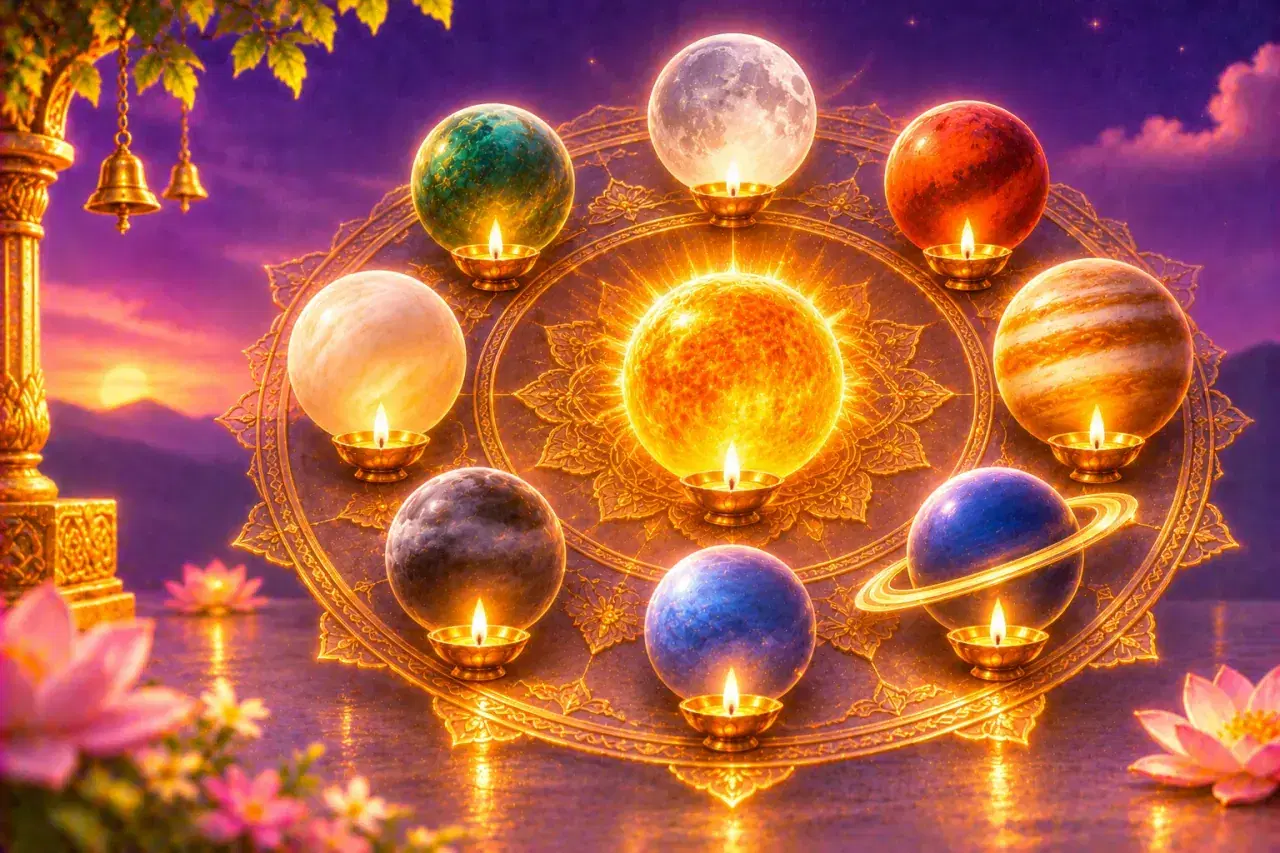
The Navagrahas, the nine "planets" of Vedic astrology, are also worshipped as deities, with temples, hymns and mantras of their own. Many families chant a planet's mantra on its weekday, or all nine in a Navagraha puja. This guide collects the traditional mantras with their meanings, and explains how they are used.
The nine grahas and their days
| Graha | Sanskrit | Weekday | Colour traditionally associated |
|---|---|---|---|
| Sun | Surya | Sunday | Red, saffron |
| Moon | Chandra | Monday | White |
| Mars | Mangal (Bhauma) | Tuesday | Red |
| Mercury | Budh | Wednesday | Green |
| Jupiter | Guru (Brihaspati) | Thursday | Yellow |
| Venus | Shukra | Friday | White |
| Saturn | Shani | Saturday | Black, dark blue |
| Rahu | Rahu | Saturday (in many traditions) | Smoky, dark blue |
| Ketu | Ketu | Tuesday or Saturday (traditions vary) | Smoky, grey |
For what each planet signifies in a chart, see the graha guides, starting with the Sun.
Name mantras (simplest)
The simplest form is to bow to the planet by name. These can be chanted by anyone at any time:
| Graha | Mantra | Meaning |
|---|---|---|
| Sun | ॐ सूर्याय नमः (Om Sūryāya Namaḥ) | Salutations to the Sun |
| Moon | ॐ चन्द्राय नमः (Om Candrāya Namaḥ) | Salutations to the Moon |
| Mars | ॐ भौमाय नमः (Om Bhaumāya Namaḥ) | Salutations to Mars, son of the Earth |
| Mercury | ॐ बुधाय नमः (Om Budhāya Namaḥ) | Salutations to Mercury |
| Jupiter | ॐ गुरवे नमः (Om Gurave Namaḥ) | Salutations to Jupiter, the teacher |
| Venus | ॐ शुक्राय नमः (Om Śukrāya Namaḥ) | Salutations to Venus |
| Saturn | ॐ शनैश्चराय नमः (Om Śanaiścarāya Namaḥ) | Salutations to Saturn, the slow-moving one |
| Rahu | ॐ राहवे नमः (Om Rāhave Namaḥ) | Salutations to Rahu |
| Ketu | ॐ केतवे नमः (Om Ketave Namaḥ) | Salutations to Ketu |
Beej (seed) mantras
Beej mantras add seed syllables that are considered to hold the essence of each graha. They are widely published in this form:
| Graha | Beej mantra (Devanagari) | Transliteration |
|---|---|---|
| Sun | ॐ ह्रां ह्रीं ह्रौं सः सूर्याय नमः | Om hrāṃ hrīṃ hrauṃ saḥ sūryāya namaḥ |
| Moon | ॐ श्रां श्रीं श्रौं सः चन्द्राय नमः | Om śrāṃ śrīṃ śrauṃ saḥ candrāya namaḥ |
| Mars | ॐ क्रां क्रीं क्रौं सः भौमाय नमः | Om krāṃ krīṃ krauṃ saḥ bhaumāya namaḥ |
| Mercury | ॐ ब्रां ब्रीं ब्रौं सः बुधाय नमः | Om brāṃ brīṃ brauṃ saḥ budhāya namaḥ |
| Jupiter | ॐ ग्रां ग्रीं ग्रौं सः गुरवे नमः | Om grāṃ grīṃ grauṃ saḥ gurave namaḥ |
| Venus | ॐ द्रां द्रीं द्रौं सः शुक्राय नमः | Om drāṃ drīṃ drauṃ saḥ śukrāya namaḥ |
| Saturn | ॐ प्रां प्रीं प्रौं सः शनैश्चराय नमः | Om prāṃ prīṃ prauṃ saḥ śanaiścarāya namaḥ |
| Rahu | ॐ भ्रां भ्रीं भ्रौं सः राहवे नमः | Om bhrāṃ bhrīṃ bhrauṃ saḥ rāhave namaḥ |
| Ketu | ॐ स्रां स्रीं स्रौं सः केतवे नमः | Om srāṃ srīṃ srauṃ saḥ ketave namaḥ |
The seed syllables are not words with dictionary meanings; tradition treats them as sounds that invoke each planet's power. Some teachers prefer that beej mantras be learned from a guru; name mantras need no such guidance.
The Navagraha shloka (all nine together)
A short, popular verse invokes all nine planets for peace:
Meaning: "May Brahma, Vishnu (Murari) and Shiva (destroyer of Tripura), the Sun, the Moon, Mars (son of the Earth), Mercury, Jupiter, Venus, Saturn, Rahu and Ketu, may all the planets bring peace."
The Navagraha Stotra
The Navagraha Stotra, traditionally attributed to the sage Vyasa, has one verse for each planet. Its first verse, to the Sun, is widely recited at sunrise:
Meaning: "I bow to the Sun, the maker of the day, red like the hibiscus flower, son of Kashyapa, of great brilliance, the enemy of darkness and destroyer of all sins."
The Sun's other great hymn is the Aditya Hridayam from the Ramayana. For the Sun, many people also chant the Gayatri mantra, which is addressed to Savitr.
How the mantras are traditionally chanted
- Day: chant a planet's mantra on its weekday, ideally in the morning after bathing.
- Count: 108 repetitions on a mala is common. Classical texts prescribe much larger counts (thousands) for formal japa anushthanas; these vary by tradition and are usually done with a priest.
- Setting: face east, light a lamp, and offer something associated with the planet, such as water to the Sun at sunrise.
- Attention: chant steadily with the meaning in mind.
A word on mantras as "remedies"
Many astrologers recommend a planet's mantra when that planet is weak or difficult in a chart, or during its dasha. Chanting can be a calming, focusing devotional practice, and many people value it deeply. It is not a guarantee of any outcome, and you never need to pay large sums for rituals or gemstones. Kundli Naksha describes these practices as tradition, not as cures.