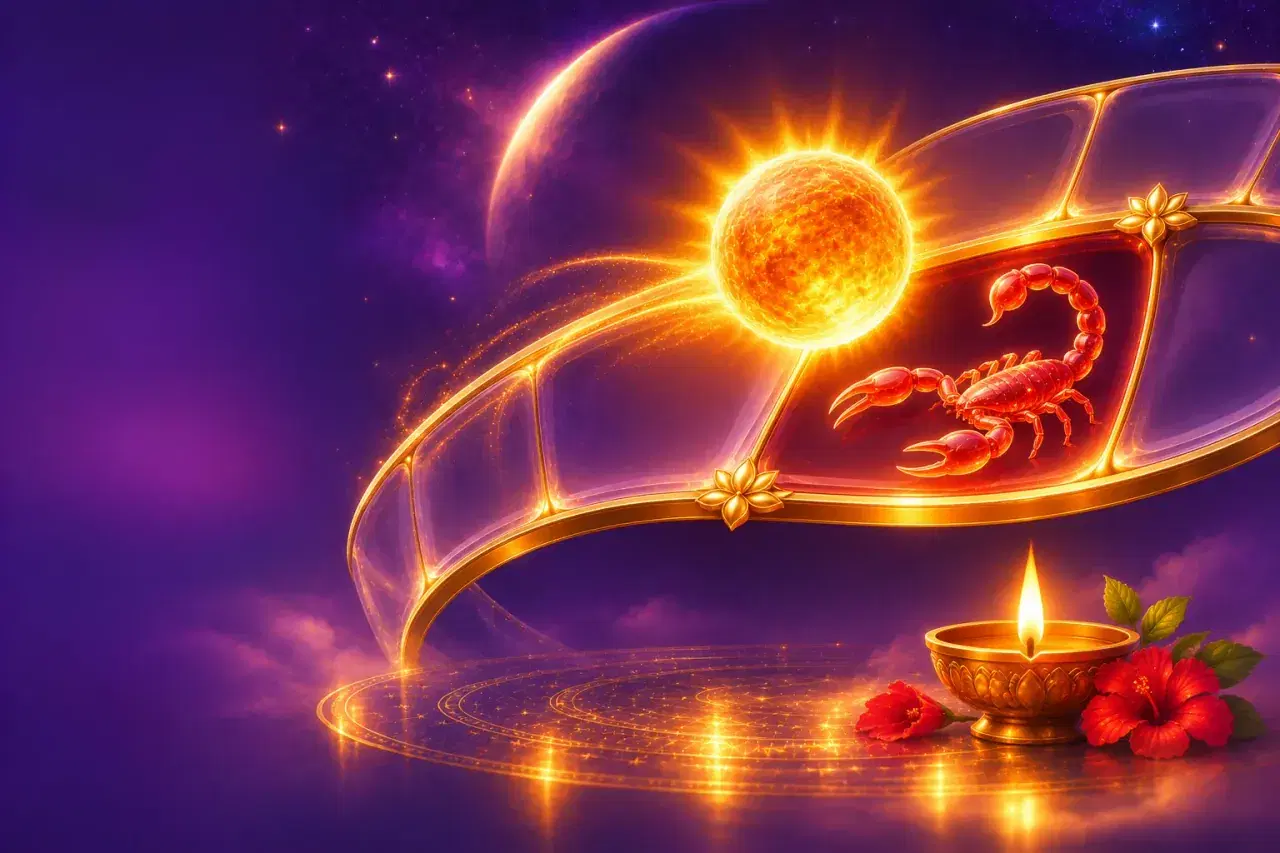
Every month the Sun moves from one sign of the zodiac into the next. Each of these moments is a Sankranti ("transition"), and twelve of them mark the Indian solar year. The best known is Makar Sankranti in January, but every Sankranti is considered a holy moment for bathing, charity and prayer. In November it is Vrishchika Sankranti, the Sun's entry into Scorpio.
Date and time in 2026
| Event | Date and time (IST) |
|---|---|
| Sun enters sidereal Scorpio | Monday 16 November 2026, 7:43 pm |
| Observance (punya kaal) | Tuesday 17 November 2026, morning |
| Sun enters Sagittarius (Dhanu Sankranti) | Wednesday 16 December 2026, 10:25 am |
Times are calculated by Kundli Naksha's engine with the Lahiri ayanamsha, the standard used by Indian Panchangs. The exact moment is the same everywhere in India; only sunrise and sunset change with your city.
Why the observance moves to the next day
The holy window around a Sankranti is called punya kaal. Traditional Panchangs place it in daylight: when the Sun changes sign after sunset, as it does this year, the observance falls on the following morning. That is why most calendars list Vrishchika Sankranti 2026 on 17 November. Different regional traditions use slightly different rules for the length of the window, so local Panchangs may vary by a few hours.
Why this is a sidereal date
Western astrology says the Sun enters Scorpio around 23 October. Vedic astrology uses the sidereal zodiac, anchored to the stars, which today is about 24 degrees behind the seasonal (tropical) zodiac. So the Indian Sankranti falls about three and a half weeks later. Our guide to the difference between Lagna and Rashi explains more about how Vedic signs are counted.
What kind of Sankranti it is
Tradition groups the twelve Sankrantis by the nature of the sign the Sun enters:
| Type | Signs | Meaning |
|---|---|---|
| Ayana Sankranti | Makara, Karka | The Sun's turning points: northward and southward journeys |
| Vishuva Sankranti | Mesha, Tula | The "equinox" Sankrantis |
| Vishnupadi Sankranti | Vrishabha, Simha, Vrishchika, Kumbha | Entries into the four fixed signs |
| Shadashiti Mukha Sankranti | Mithuna, Kanya, Dhanu, Meena | Entries into the four dual signs |
Vrishchika Sankranti is a Vishnupadi Sankranti, one of the four entries into fixed signs. Texts on dharma recommend bathing, prayer to Surya and Vishnu, and charity at these times.
How it is observed around India
- Bathing and charity: a holy dip in a river or at home before sunrise on 17 November, followed by offering water (arghya) to the Sun and giving food, clothes or money to those in need.
- Kerala: Vrishchika Sankranti begins the Malayalam month of Vrischikam, and the first day of Vrischikam opens the Mandala season of the Sabarimala pilgrimage. Many devotees begin their 41-day vrat around this time.
- Tamil Nadu: the Tamil month of Karthigai begins, the month of Karthigai Deepam.
- Bengal and Odisha: the solar month of Agrahayan (Margashirsha) begins.
- Everyday practice: many families simply light a diya, recite the Gayatri mantra or the Aditya Hridayam, and give a little in charity.
The Sun in Scorpio: what it means astrologically
Scorpio is a fixed water sign ruled by Mars, a natural friend of the Sun, so the Sun is in a friendly sign during this month. Scorpio's themes of depth, research, hidden matters and transformation colour the Sun's significations of authority, vitality and purpose. Traditionally it is a good month for focused, determined work and for completing difficult tasks.
By Moon sign
Transits are read from the Moon sign. Classical texts give the Sun its best transit results in the 3rd, 6th, 10th and 11th houses from the Moon. From 16 November to 16 December 2026, that favours four Moon signs:
| Moon sign | Scorpio is your… | Traditional emphasis |
|---|---|---|
| Gemini | 6th house | Favourable: health routines, competition and service |
| Virgo | 3rd house | Favourable: courage, communication and initiative |
| Capricorn | 11th house | Favourable: gains and recognition from seniors |
| Aquarius | 10th house | Favourable: career visibility and authority |
| Other Moon signs | 1st, 2nd, 4th, 5th, 7th, 8th, 9th or 12th | A month to pace yourself and keep plans steady |
The Sun's transits are brief and mild compared with those of slow planets like Saturn and Jupiter. For the bigger picture of the season, see our guide to the Mars transit in Leo, which runs through the same weeks.