Ask a family in Maharashtra, Bengal, Andhra Pradesh or Odisha how they celebrated a new home or a wedding, and you will often hear: "We did Satyanarayan puja." It is one of the most popular home pujas in India: flexible, welcoming to the whole family, and centred on gratitude and truthfulness. This guide gives you everything you need to perform it.
What Satyanarayan puja is
Satyanarayan (satya, truth + Narayana, Vishnu) is Vishnu worshipped as the embodiment of truth. The puja and its katha are traditionally attributed to the Reva Khanda of the Skanda Purana, though many scholars consider the katha a later, much-loved addition to the Puranic literature. Its message is simple: keep your promises, honour the Lord with sincerity, and do not neglect the prasad or the vow once made.
When to perform it
| Occasion | Notes |
|---|---|
| Purnima (full moon) | The most traditional day; many families do it every Purnima |
| Ekadashi, Sankranti, Thursday | Also common |
| Griha pravesh (new home) | Very popular |
| Wedding, anniversary, birthday, naming ceremony | Thanksgiving |
| New job, business, exam result, recovery | Fulfilment of a wish (mannat) |
The puja is usually done in the evening, though morning is also fine. Find the next Purnima in the Panchang, or a specific date with the muhurat finder.
Samagri (what you need)
| Category | Items |
|---|---|
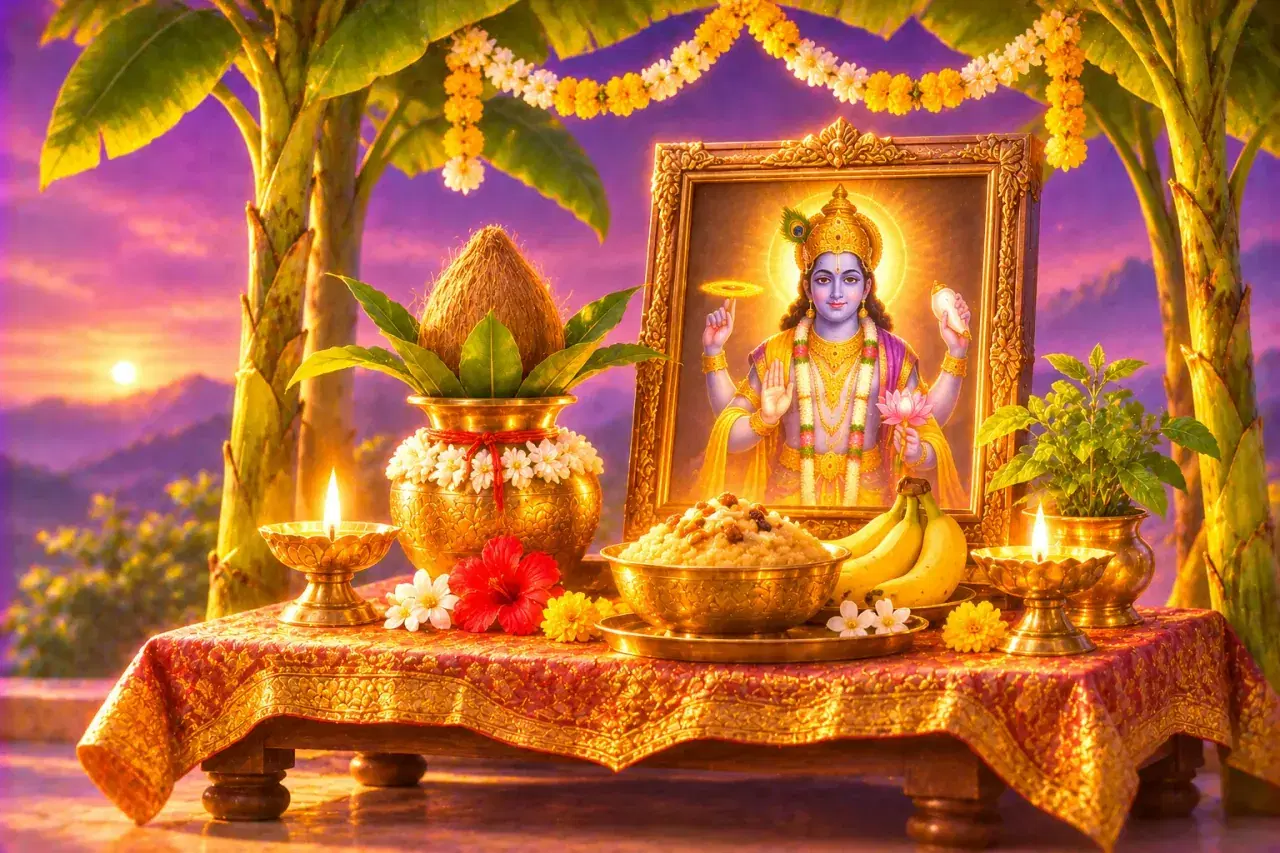
| Altar | Wooden chowki, yellow or red cloth, banana stems or leaves for a mandap, rangoli |
| Deity | Picture or idol of Satyanarayan (Vishnu); a small Ganesha idol or a betel nut for Ganesha |
| Kalash | Copper or brass kalash with water, mango leaves, coconut with red cloth, a coin, betel nut, rice |
| Worship | Haldi, kumkum, sandalwood paste, akshat (unbroken rice), flowers and garlands, tulsi leaves, incense, ghee lamp, camphor, betel leaves and nuts |
| Panchamrit | Milk, curd, ghee, honey and sugar |
| Navagraha | Nine small heaps of rice or grains, or a Navagraha picture |
| Prasad | Sheera (recipe below), bananas and fruits, dry fruits |
| Others | Sacred thread, janeu, small cloth for the deity, bell, conch (optional), a book or printout of the katha |
Step-by-step vidhi
Families vary the details; a priest may add Vedic mantras. A simple home version:
- Prepare. Bathe, wear clean clothes, clean the space and draw a rangoli. Set up the chowki facing east or north, with a banana-leaf mandap if possible.
- Achaman and sankalpa. Sip water three times while chanting names of Vishnu, then state your intention: who is doing the puja, where, on which date, and for what purpose.
- Ganesh puja. Worship Ganesha first with water, kumkum, akshat, flowers and a sweet. (Read the stories of Lord Ganesha for why he comes first.)
- Kalash sthapana. Install the kalash on a heap of rice, invoke the holy rivers into its water, and worship it.
- Navagraha puja. Worship the nine planets on their rice heaps, asking for their goodwill.
- Satyanarayan puja. Invoke the Lord into the image and offer the traditional services: water to wash the feet and hands, panchamrit bath, clean water, cloth and sacred thread, sandalwood, akshat, flowers and tulsi, incense, lamp and the food offering (naivedya) of sheera and fruits.
- Katha. Read or listen to the five chapters of the Satyanarayan katha (summarised below). Family members sit together and listen with folded hands.
- Aarti. Perform aarti with camphor and a ghee lamp, singing Om Jai Lakshmi Ramana or Om Jai Jagdish Hare.
- Prasad. Offer the prasad, then distribute it to everyone present. Tradition stresses that everyone should take prasad: it is a lesson of the katha itself.
- Close. Ask forgiveness for any mistakes (kshama prarthana).
How to make the sheera prasad
The classic prasad is sheera (suji halwa), made in the proportion 1 : 1 : 1 : 1:
- 1 cup semolina (rava), 1 cup ghee, 1 cup sugar, 1 cup milk (some use 2 cups milk or water)
- 1–2 ripe bananas, mashed or sliced
- Cardamom, a few tulsi leaves, cashews and raisins
Roast the semolina in ghee until fragrant and golden, add warm milk carefully, then sugar and banana, stir until it leaves the pan, and finish with cardamom, nuts and tulsi. Many families call this measure sava (one and a quarter) and use 1¼ of each.
The Satyanarayan katha in brief
The katha has five chapters. In the first, Lord Vishnu tells the sage Narada about the vrat; the rest are stories of people who kept or broke it.
| Chapter | Story |
|---|---|
| 1 | Narada, distressed by the suffering of people on earth, asks Vishnu for a remedy. Vishnu describes the Satyanarayan vrat: worship with devotion, the katha, and prasad shared with all. |
| 2 | A poor Brahmin of Kashi, guided by the Lord in disguise, performs the puja and becomes prosperous. A woodcutter sees him, performs it too, and his life improves. |
| 3 | A merchant named Sadhu vows to perform the puja if he is blessed with a child. A daughter, Kalavati, is born, but he keeps postponing the vow. Misfortune follows: he and his son-in-law are falsely imprisoned. |
| 4 | When the merchant finally performs the puja, he is freed. On his way home, he lies to the Lord in disguise about his cargo and loses it, until he repents. As his boat returns, Kalavati rushes to meet her husband without taking the prasad; the boat sinks, and returns only when she goes back and accepts it. |
| 5 | King Tungadhwaja scorns prasad offered by humble cowherds and loses his kingdom and family; when he humbly joins their puja and takes the prasad, everything is restored. |
The chapters repeat one message in different forms: keep your word, act with humility, and honour the sacred however humble the offering or the person offering it.